Dr Robert Lee, Steve Zhang
Australian AI Music Alliance
Abstract
In recent years, with the rapid advancement of Artificial Intelligence (AI)-generated music, the traditional music industry has been facing systemic challenges in areas such as copyrights confirmation, royalty distribution, and provenance authentication. The current International Standard Recording Code (ISRC) system has not adequately accounted for the uniqueness of AI-generated works, leading to increased strain on the existing identification system, dilution of creator royalties, growing disputes over copyright ownership, and deficiencies in music data tracking mechanisms. The Australian AI Music Alliance believes that currently the top priority is to upgrade the current ISRC framework to effectively identify and manage AI-generated music. To address this, this paper proposes the establishment of a global standardized AI Music identifier based on ISRC-AAM-CID. This new standard builds upon the existing ISRC system by introducing an innovative AI music participation weighting algorithm to expand the AI Application Music (AAM) field. Additionally, it integrates a decentralized storage solution (CRUST) to generate a corresponding CID field, enabling blockchain-based provenance authentication. By implementing this standardized framework, AI-generated music can be accurately categorized, music copyright management will become more standardized and transparent, royalty distribution mechanisms will be optimized scientifically, and the full traceability of AI music will be ensured, fostering fair competition in the AI era, safeguarding the rights of human creators, and promoting the sustainable development of the global music industry.
1. Introduction
The music industry is a dynamic, creative, and transformative field, deeply driven by technology. Throughout the process of creating and distributing every musical work, a clear metadata and identifier system is an essential technical means and legal basis to ensure the originality of works, ownership, transparency of revenue distribution, and improved industry efficiency. International standardized identifier systems, such as ISWC (International Standard Musical Work Code), ISRC (International Standard Recording Code), and IPN (International Performer Number) have played a crucial role in supporting human-created music ecosystems, providing a solid foundation for the operation of the global music market.
However, with the widespread application of AI in music, the way music is created is undergoing an unprecedented transformation. AI-generated music, with its extremely low cost and high efficiency, has broken traditional creative boundaries, leading to an exponential increase in the number of music works, dilution of royalty distribution, and ambiguity in copyright ownership. These changes pose significant challenges to the existing metadata and identifier systems, creating an urgent need for an innovative and scalable solution to meet the unique demands of AI music.
This paper focuses on the core issues and solutions the music industry faces in the era of AI-generated music. First, it explores the traditional music industry ecosystem, analyzing the importance of each stage in the two-way flow between creators and listeners. It then examines the critical role and limitations of metadata and identifiers in the current music management system. Based on this, the paper conducts an in-depth analysis of the impact of AI music on existing systems and proposes a new identification system, expanding ISRC with the AI Application Music (AAM) field, combined with decentralized storage and blockchain technology, to provide a transparent management and fair competition solution for AI music.
Finally, this paper envisions the future of AI music in the standardization and globalization process, proposing to promote international organizations (such as CISAC, IFPI, and ISO) to adopt this AI music identification proposal for automated tracking and management. Through this research, we aim to build a highly efficient and fair ecosystem that can address the challenges of the AI era in the music industry, laying a solid foundation for the future of music creation and revenue distribution sustanably.
2. The Music Industry Ecosystem: The Two-Way Cycle of Music Creation and Revenue Distribution
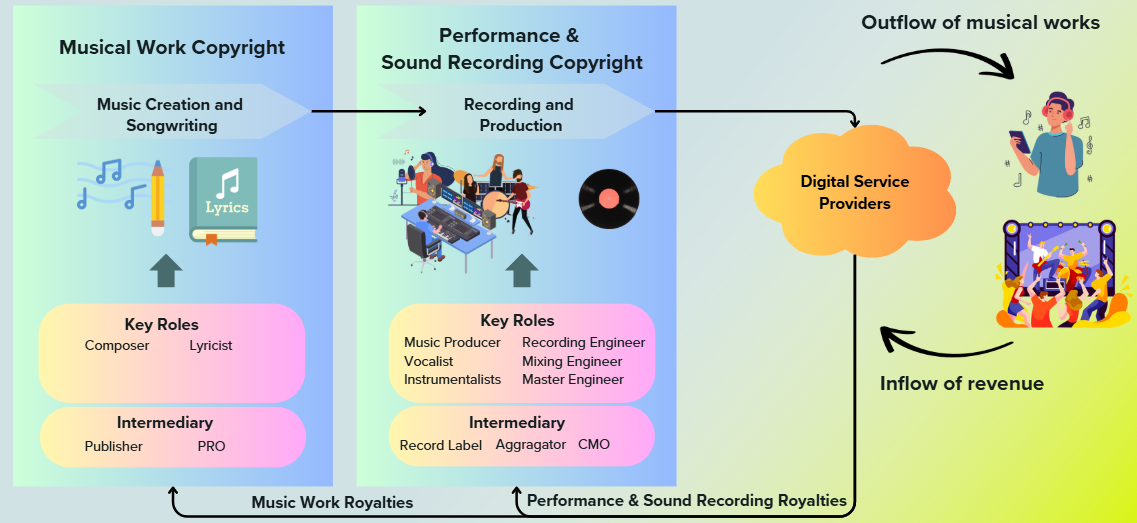
The music industry ecosystem is a highly complex and collaborative system that ensures music creators, performers, record labels, music distribution platforms, and other rights holders work together to support the circulation of musical works while ensuring a fair distribution of royalties. This chapter explores the dual-flow mechanism of the music industry, illustrating how musical works move from creators to listeners and how revenue cycles back to creators, offering deep insights into the fundamental dynamics of the industry's operations.
The music industry is not only a vital part of the cultural sector but also a complex economic system with significant commercial value. It connects creators with listeners while encompassing intricate copyright management, revenue distribution, and technological advancements. As streaming platforms gradually replace traditional music consumption methods, the emergence of the digital music ecosystem has made the industry's operational model more multi-layered and multidimensional.
The operational mechanism of the music industry can be divided into two key processes: the outflow of musical works (Outflow Journey) and the inflow of revenue (Inflow Journey). The outflow process illustrates the journey of a musical work from its creator to the market and ultimately to the listener, while the inflow process explores how revenue flows back to the creators. Together, these interconnected processes form the commercial cycle of the music industry.
2.1 How Musical Works Move from Creators to Listeners
The journey of a musical work from creative conception to audience consumption involves multiple stakeholders and technological platforms. This process includes songwriting, recording, and distribution.
2.1.1 Songwriting
The birth of a musical piece begins with creative inspiration, with songwriting at its core. The creators may be individual composers and lyricists or collaborative teams. During the songwriting process, creators must consider the compatibility of melody and lyrics while aligning with market trends, balancing artistic value with commercial potential.
In some cases, music publishers may also be involved in the creation stage, providing collaboration opportunities for songwriters and assisting in managing copyrights and promoting works. If songwriters sign a contract with a publishing company, the publisher typically helps them connect with performers or recording teams and facilitates the commercial use of their compositions.
2.1.2 Recording
Once songwriting is complete, the work enters the recording phase. In modern music production, this process involves collaboration among various professionals, including vocalists, instrumentalists, music producers, recording engineers, and mixing engineers. Recording is not a single step but a refined process that includes tracking, mixing, and mastering.
Record labels play a crucial role in this phase, especially for signed artists. Record labels typically finance music production and take charge of promotion and marketing. Independent musicians, on the other hand, may choose to self-fund their recordings or collaborate with third parties for production.
2.1.3 Distribution
After recording is complete, music must be brought to the market. This process involves distributors, digital music platforms, and other media. In the past, music distribution mainly relied on physical albums, but today, streaming platforms have become the dominant distribution channels.
Digital music distribution is often handled by aggregators such as TuneCore, DistroKid, and CD Baby, which help independent musicians upload their works to major platforms like Spotify, Apple Music, and YouTube Music. Additionally, large record labels have their own distribution networks to manage their artists' releases directly.
Apart from streaming, other significant channels for music dissemination include radio, television, film, and advertising. Synchronization licensing (Sync Licensing) plays a critical role in this process. For example, film production companies must obtain synchronization licenses to use songs in movies or advertisements, and such licensing is typically managed by music publishers or record labels.
2.2 How Revenue Cycles Back to Creators
Once a musical work is successfully released and consumed by listeners, the next phase involves revenue inflow. Music revenue sources are diverse, including streaming, digital downloads, physical sales, radio play, synchronization licensing, and live performances. However, music revenue does not flow directly to creators but is distributed through various royalty allocation mechanisms.
2.2.1 Major Revenue Sources
In today’s music market, streaming is the dominant revenue source. Platforms such as Spotify and Apple Music pay royalties to rights holders based on play counts, while video platforms like YouTube generate revenue through ad-sharing models. Additionally, digital downloads (such as iTunes purchases) and physical album sales (such as vinyl records) remain key revenue sources for certain artists and labels.
Music played in public spaces—such as radio stations, shopping malls, gyms, and cafes—also generates royalties. These public venues typically pay performance royalties via Collective Management Organizations (CMOs) to ensure fair compensation for music creators.
2.2.2 Revenue Distribution Mechanisms
Music revenue distribution involves multiple rights holders, including songwriters, music publishers, performers, instrumentalists, record labels, and producers. Songwriters and music publishers receive income through musical work copyrights, while performers and record labels earn revenue from performance and sound recording copyrights.
To ensure creators receive fair compensation, they must provide complete and accurate metadata, documenting the creation, production, and performance details of their works. This includes information about contributors, locations, and dates. Additionally, creators need to register all necessary identifiers to ensure their works are correctly recognized and tracked in copyright management systems. Notably, accurate entry and maintenance of this key information enable CMOs and related organizations to identify creators and distribute royalties appropriately. The next chapter will focus on discussing this aspect in depth.
3. The Key Foundations of Earning Revenue: Credits, Identifiers, and Metadata
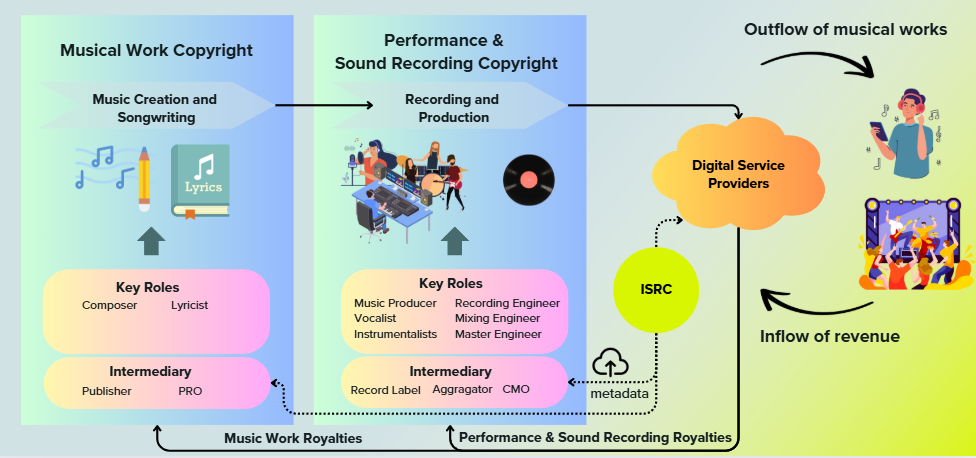
In the music industry, credits are essential for protecting creators' rights and ensuring they receive fair compensation. However, due to the vast number of musical works, creators may struggle with proper attribution due to name similarities, spelling errors, or language differences. To address this issue, the industry utilizes metadata and five key identifiers—ISWC, ISRC, IPI, IPN, and ISNI—to accurately identify musical works, sound recordings, and rights holders. These identifiers help ensure that creators receive correct payments when their music is used. This chapter explores the importance of credits in the music industry, emphasizing the role of identifiers and metadata in effective music rights management.
Credits and earnings for music creators are essential components of the music industry. Credits not only serve as public recognition of a creator's contribution but also directly impact revenue distribution. Music creators can earn compensation through royalties, advance payments, and one-time fees, but this depends on their works being accurately identified and recorded.
Given the vast number of new songs released daily, involving numerous creators and rights holders, it is crucial to accurately document contributors, usage details, and revenue distribution. However, traditional text-based record-keeping methods struggle to ensure accuracy due to issues such as duplicate song titles, identical creator names, and language differences.
To address this challenge, the music industry utilizes metadata and five key identifiers—ISWC, ISRC, IPI, IPN, and ISNI—to uniquely identify musical works, sound recordings, and rights holders. This system not only enhances the efficiency of copyright management but also ensures that creators receive fair credit and compensation when their works are used.
3.1 The Importance and Standardization of Credits
Credits serve as formal recognition of a creator’s contribution to a musical work, live performance, or sound recording. For example, credits can be found on CDs, vinyl record covers, and album descriptions on digital streaming platforms. They are not only essential for the creators themselves but also help establish a connection with the audience. However, the role of credits goes beyond just identity recognition—they are a crucial component of the payment system in the music industry.
3.1.1 Why Proper Credits Are Essential
Proper credits ensure that listeners can identify the creators of a musical work while also serving as a safeguard for creators to receive their rightful earnings. When a musical work or sound recording is used, credit information is essential for processing copyright payments. Without proper credits, creators may struggle or even fail to claim the revenue they are entitled to. Additionally, every musical work and sound recording should include complete credit details to ensure clear ownership attribution.
If a musical work or sound recording lacks proper credits, it may lead to disputes over ownership and revenue distribution, including copyright infringement and contract violations. Additionally, removing or altering metadata may constitute copyright infringement, as metadata is often protected under copyright law.
3.1.2 When Should Creators Receive Credit?
Creators who make an original contribution to a musical work, live performance, or sound recording should receive appropriate credit. However, credit attribution is influenced by various factors, such as the type of contribution, collaboration agreements, legal regulations, and how the work is used. As a result, not everyone involved in the creative process automatically qualifies for credit; instead, it must be determined based on industry standards and specific agreements.
3.1.3 How to Properly Credit Creators
In live performances, singers and other on-stage performers are typically credited. If the songwriters are not performers or band members, their contributions should still be acknowledged. However, the way credits are given may vary depending on industry practices and specific circumstances.
To ensure proper credit, it is essential to accurately record all contributors' information—including songwriters, performers, and other rights holders—when registering and releasing a musical work or sound recording. Additionally, industry-standard identifiers such as IPI (Interested Party Information), IPN (International Performer Number), and ISNI (International Standard Name Identifier) should be included.
Additionally, obtaining accurate credit information should be done at the right time. For example, creators need to confirm the final mixed version of the recording to ensure that the correct performers are credited, avoiding the misattribution of individuals from earlier recording versions to the final work.
Although credit management may seem straightforward, the music creation and recording process often spans several years, involving multiple countries, studios, and various creators. Due to this extended timeline, information may be forgotten, misrecorded, or even completely omitted. Therefore, creators should confirm credit and rights distribution with collaborators as early as possible before the official release to ensure their rights are properly protected.
3.2 What Are Identifiers?
Identifiers are unique codes used to distinguish creators and their works while ensuring they receive proper credits and compensation. In the music industry, many songs have identical names, and creators may have similar names or different spellings due to language differences. Relying solely on textual information to verify identity and distribute royalties is not reliable.
To solve this challenge, the music industry has implemented five core identifiers. These unique codes are essential for tracking royalties, payments, and rights distribution whenever a musical work or sound recording is used. Music publishers, record labels, CMOs, and DSPs use these codes to accurately identify creators, musical works, and sound recordings. They also track playback data to ensure royalties are correctly distributed to relevant rights holders, including creators, publishers, and record labels.
The Five Key Identifiers in the Music Industry:
- ISWC (International Standard Musical Work Code): Uniquely identifies a musical composition.
- ISRC (International Standard Recording Code): Uniquely identifies a sound recording or music video.
- IPN (International Performer Number): Uniquely identifies performers and their contributions.
- ISNI (International Standard Name Identifier): Uniquely identifies individuals, organizations, and companies in creative industries.
- IPI (Interested Party Information): Uniquely identifies songwriters and publishers, ensuring proper royalty distribution.
The accurate use of these identifiers is critical for copyright management, revenue tracking, and ensuring music creators receive their rightful compensation. The following sections provide a detailed explanation of each identifier.
3.2.1 ISWC
ISWC is an internationally recognized unique identifier composed of 11 characters (numbers and letters). This code is assigned to a musical work after it is registered with a CMO.
The primary purpose of ISWC is to uniquely identify a musical work and link it to essential metadata, such as the work’s title, the names of songwriters, and their IPI numbers. ISWC codes are integrated into databases and data exchange formats that store copyright information, including publishing details and revenue distribution. By having this information properly recorded, the usage of musical works can be more easily tracked, ensuring that creators receive accurate payments when their works are used.
Each unique musical work is assigned a single ISWC. Even if a song has multiple recorded versions (such as covers or remixes), each recording may have different ISRC codes, but they all correspond to the same ISWC code of the original composition.
Most CMOs, acting as official ISWC registration agencies, assign ISWC codes when a musical work is registered. Songwriters can look up ISWC registration agencies on the ISWC website. When applying for an ISWC, a minimum set of descriptive metadata must be provided. If a musical work has multiple songwriters, all their IPI numbers must be included to complete the registration process and obtain the ISWC code.
The core metadata required to apply for an ISWC includes the work title, the names of all songwriters, their IPI numbers, and their role codes. For arrangements, information on the original work is required for proper linkage.
ISWC is the standard identification method for musical works in the music industry. It is unique and essential for songwriters to receive royalties from CMOs and other revenue sources. Proper registration and tracking of ISWC are crucial, as this code connects compositions to their recordings, supports reporting of play data, and ensures accurate royalty distribution.
3.2.2 ISRC
ISRC is a 12-character alphanumeric code uniquely assigned to a specific sound recording or music video.
ISRC serves as the permanent and unique identifier for recordings and music videos. In large music databases, ISRC codes improve data management efficiency and accuracy, preventing confusion caused by multiple versions (e.g., remixes, cover versions) or metadata inconsistencies. For example, remixes and cover versions need to be distinguished from the original recording, and ISRC ensures that each version has a distinct identifier.
ISRC is also used to track how recordings and music videos are utilized across different media platforms, such as radio, television, and streaming services, ensuring that performers and recording rights holders receive appropriate compensation when their works are played. Additionally, ISRC codes link recordings to their corresponding musical compositions.
The ISRC is widely used by Digital Service Providers (DSPs), music distributors, record labels, music publishers, and CMOs for data management, tracking, and rights administration.
Each sound recording has a unique ISRC, which means that even different recordings of the same musical work—such as studio versions, live performances, remixes, or cover versions—will each be assigned a distinct ISRC. Additionally, music videos are also assigned an ISRC. Since music videos involve video production and recording, their contributors may extend beyond those of the sound recording. Therefore, even if a music video uses the exact same audio as a sound recording, it still requires a separate ISRC.
Any producer of a sound recording can apply for an ISRC prefix, which is a unique 5-character alphanumeric code that allows the generation of up to 100,000 ISRCs per year. The application for an ISRC prefix should be submitted to the designated ISRC registration agency in the applicant's region or the international ISRC registration authority. The ISRC prefix must be used to assign a unique ISRC to each recording before its official release.
If a recording has not yet been assigned an ISRC, any rights holder or exclusive licensee can request an ISRC from an ISRC Manager. ISRC Managers—often digital aggregators or music distributors—are authorized to assign ISRCs as needed. Once an ISRC is assigned, it permanently belongs to that specific recording and is used as its unique identifier in all contexts.
The ISRC is essential for ensuring that your sound recordings and music videos are always accurately identified. It is unique and plays a crucial role in data management, royalty payments, and revenue for music creators. Be sure to record and track your ISRC, as it is not only used to link sound recordings to musical works but also to report play counts and earnings, ensuring that songwriters and performers receive accurate compensation.
3.2.3 IPI
IPI is used to assign an 11-digit unique identifier to creators (such as songwriters) or legal entities with rights in a musical work (such as music publishers). IPI primarily serves to identify rights holders, record their agreements with CMOs, and act as a key identifier when registering musical works.
The IPI number enables CMOs to efficiently and accurately distribute royalties, remunerations, and other payments, preventing confusion caused by identical names, spelling errors, or special characters. By using the IPI number for identification instead of relying solely on names, the accuracy and efficiency of payment processing are significantly improved, particularly for creators or organizations with the same name.
To obtain an IPI number, you must join a CMO that is a member or client of CISAC (International Confederation of Societies of Authors and Composers). Once successfully registered, your CMO will assign you an IPI number.
Your IPI number and related information will be securely stored in an international database operated by SUISA (Swiss Society for the Rights of Authors of Musical Works) on behalf of CISAC. This allows other CMOs worldwide to identify you using your IPI number whenever your musical works are used globally, ensuring that you receive the royalties you are entitled to.
The IPI number serves as the unique identifier for songwriters and music publishers when creating and registering musical works. Every time you contribute to a musical composition and register it, your IPI number is used for tracking, payment, and royalty management. Think of your IPI number as your personal "social security number"—you should remember it and use it correctly for every musical work you are involved in. This ensures that your rights are protected and that you receive accurate compensation for your contributions.
3.2.4 IPN
IPN is a unique identifier assigned to artists who are registered with a performers' CMO. These CMOs represent performers and manage their related rights, including neighboring rights or other rights established under copyright law.
IPN applies not only to live performers but also to all artists involved in the creation of a recording or audiovisual work. In the music industry, IPN identifies singers, band members, orchestral musicians, session musicians, and backing vocalists.
By using IPNs, CMOs can accurately identify all performers who have contributed to a sound recording, ensuring that royalties, remunerations, and other payments are properly allocated to the rightful performers. Since each IPN is unique, using it instead of relying solely on performer names helps improve accuracy and efficiency in payment management. This is particularly important when dealing with performers who have the same name, unique spellings, or different character sets, as IPNs eliminate identification confusion.
To obtain an IPN, a performer must register as a member of a performers' CMO that is either a member of SCAPR or has an agreement with SCAPR. SCAPR (Societies’ Council for the Collective Management of Performers’ Rights) is an international organization that represents and facilitates cooperation among performers' CMOs worldwide. SCAPR manages the IPD (International Performer Database), which contains records of over 1,000,000 performers globally, assigning each performer a unique IPN.
IPN is the performer’s unique identifier for each recorded performance. It is crucial because it ensures that performers receive the royalties and revenue they are entitled to. Think of your IPN as the "social security number" for performers—it must be remembered and included in all recordings you participate in to safeguard your earnings and rights.
3.2.5 ISNI
ISNI is an ISO international standard. Like IPI and IPN, ISNI is a unique and reliable identifier, but it serves a broader range of industries and roles.
While IPI and IPN are mainly used for music industry contributors and rights holders, ISNI applies to a wider variety of creators, including authors, visual artists, inventors, and filmmakers. ISNI allows CMOs and other organizations to accurately identify creators and their various public identities, such as pseudonyms or stage names. Additionally, ISNI can be used to identify non-human entities like music publishers and record labels. For CMOs and DSPs that cannot assign IPI numbers, ISNI is a critical tool for ensuring that rights holders receive accurate compensation.
ISNI is a public identifier that can be linked to IPI, IPN, ISWC, and ISRC, ensuring that a creator’s contributions across multiple roles are properly recognized and tracked.
By integrating information from these identifiers, ISNI can help track all contributions made by a creator, whether as a songwriter, performer, or owner of a sound recording, ensuring that rights are clearly identifiable. ISNI enables the unique recognition of your public identity, ensuring that the use of your musical works or sound recordings can be accurately tracked, thereby securing proper credits and compensation.
3.3 What is Metadata?
Metadata refers to information about creators, other rights holders, musical works, and sound recordings. When discussing metadata in the music industry, we refer to the details describing musical works, recordings, and contributors, which help clarify ownership and ensure all contributors receive proper recognition.
In many countries, metadata is protected under copyright law and is classified as Rights Management Information (RMI), embedded within Technical Protection Measures (TPM) to prevent unauthorized modifications or removals.
3.3.1 Types of Metadata
Metadata can be categorized into four primary types:
- Descriptive Metadata
Information about musical works and sound recordings, most of which can be accessed by listeners, including:
- Title of the song
- Main Artist
- Album, EP, or Single
- Version
- Initial release year
- Genre
- Duration
- Songwriters
- Music producer
- Performers (instrumentalists, vocalists)
- Recording engineers, mixing engineers, mastering engineers
- Recording studio and mastering studio
- Recording equipment used
- Lyrics
- Sound recording or music video
- Rights Metadata
Rights Metadata records information about rights holders, unique identifiers, and royalty distribution details. It includes:
- Rights holders (e.g., songwriters, publishers, performers)
- Rights holders' identifiers (IPI, IPN, ISNI)
- Key identifiers for musical works and sound recordings (ISWC, ISRC)
- Rights ownership percentages and royalty splits
Some information may be confidential (such as ownership percentages and royalty splits) and not publicly disclosed.
- Performance or Usage Metadata
This type of metadata is used to track the usage of musical works and sound recordings, including but not limited to:
- Number of streams
- Number of downloads or sales
- Radio airplay count
- Broadcast time on television
This data helps calculate royalties and ensures that rights holders receive their corresponding compensation.
- Recommendation Metadata
Recommendation metadata is primarily used by DSPs to recommend songs, creators, and playlists to listeners. The standards for recommendation metadata vary across different DSP platforms but typically include:
- Genre
- Mood
- Tempo
- Language
The accuracy of recommendation metadata directly impacts the effectiveness of personalized recommendation systems, helping listeners discover music content that better matches their preferences.
3.3.2 Why Metadata is Crucial
Complete metadata, including key identifiers, ensures that creators receive proper credits and that all contributions are correctly recorded; music usage is accurately tracked, ensuring rights holders receive their fair share of royalties and revenue; music discoverability is enhanced, allowing listeners to find specific songs more easily.
For instance, when users search for a song on streaming platforms, accurate metadata ensures the song appears correctly in search results. Moreover, when streaming platforms recommend new music to users, their recommendation systems rely on metadata to match listeners with songs that suit their tastes.
Metadata is essential for protecting creators' rights, driving music market development, and enhancing the user experience.
4. AI Music Revolution: The Impact on Existing Metadata and Identifiers
AI music has emerged as one of the most significant innovations in the music industry in recent years. By leveraging technologies such as machine learning and neural networks, AI can autonomously or assistively generate musical works, playing a crucial role in fields such as film, gaming, streaming, and music composition. This chapter focuses on exploring the definition of AI music, its generation methods, advantages, and challenges, aiming to provide a reference for AI music research and industry development.
In recent years, AI technology has made breakthrough advancements across various fields, particularly in artistic creation. AI is increasingly demonstrating its capabilities in music generation, arrangement, and mixing. AI-generated music not only helps professional musicians improve creative efficiency but also enables ordinary users to easily create personalized music. However, the rise of AI music has also sparked widespread discussions regarding copyright ownership, creator compensation, and tracking management.
4.1 What is AI Music?
AI music is an emerging form of music creation and generation that utilizes artificial intelligence technology. Through deep learning, neural networks, and other AI algorithms, computers can analyze vast amounts of musical data, learn the underlying patterns and styles, and subsequently generate new musical compositions. This technology is capable of producing melodies, harmonies, and rhythms, as well as performing tasks such as mixing, arranging, and even simulating human vocals.
The core of AI music lies in algorithms and data. By collecting and analyzing vast amounts of musical data, AI systems can identify the characteristics and patterns of different musical styles. This data includes various dimensions such as melody, harmony, rhythm, and lyrics. Based on this data, AI systems use deep learning technology to build complex neural network models, enabling them to generate new musical compositions.
Currently, leading AI music production tools such as Suno and Udio allow users to input text descriptions, and the platform automatically generates matching melodies, lyrics, and accompaniments while also providing AI-generated vocals. These platforms also offer advanced features such as song extension, style selection, vocal separation, and cover song generation, enabling anyone to turn their imagination into polished musical creations.
4.2 AI Music Creation Process
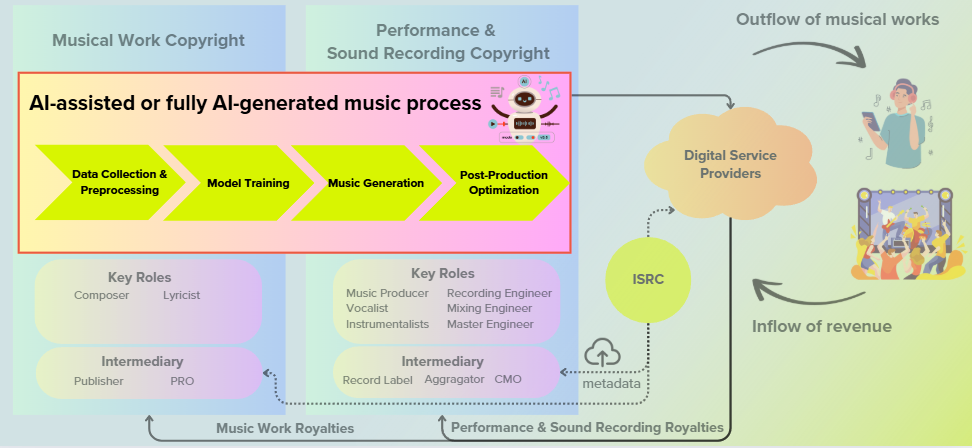
The AI music generation process can be divided into four key phases: data collection & preprocessing, model training, music generation, and post-production optimization. These steps work together to form a complete AI music production system.
4.2.1 Data Collection & Preprocessing
The first step in AI music generation is data collection and preprocessing. AI must learn from vast amounts of musical data to understand and replicate the structure, style, and elements of music. This data typically includes audio files across various genres, MIDI files (which record digital instrument performance data), and corresponding musical scores.
- Data Collection: The quality and diversity of data are crucial. To train AI models, developers typically gather datasets covering classical, pop, electronic, jazz, and other music genres. Additionally, a variety of instrument tones and performance techniques are included. Some AI music platforms obtain extensive databases through licensing agreements to ensure a broad learning and analytical foundation.
- Data Preprocessing: The goal of preprocessing is to transform collected audio and MIDI data into formats suitable for AI learning. This may involve segmenting audio files, standardizing pitch and rhythm, removing background noise, and converting audio into spectrograms or other visual formats. MIDI data also needs to be converted into machine-readable sequences so the AI can identify and generate appropriate notes and rhythms.
- Data Labeling & Classification: To enhance learning efficiency, datasets are often labeled and categorized. Developers classify data based on attributes like emotion, style, tempo, and harmony, providing these labels during training to help the model better control musical expression.
4.2.2 Model Training
After preprocessing the data, the next step is training the AI model. AI music generation relies heavily on deep learning techniques, particularly neural network models. Common models include:
- Generative Adversarial Networks (GANs): GANs are widely used in AI music generation. They function through a generator (which creates music) and a discriminator (which evaluates whether the generated music is real or AI-made). The generator continuously improves through adversarial training, producing high-quality compositions.
- Recurrent Neural Networks (RNNs): RNNs are particularly well-suited for processing sequential data like musical note sequences. Their key advantage is the ability to remember and process long-term dependencies in music. With Long Short-Term Memory (LSTM) units, RNNs capture broader structural dependencies, making them effective for generating complex melodies and harmonic progressions.
- Variational Autoencoders (VAEs): VAEs are another popular generative model that learns the latent space of music to generate new musical segments. Unlike GANs, the generation process of VAEs is smoother and more stable, making them particularly suitable for creative and highly diverse music generation tasks. By adjusting variables in the latent space, VAEs can generate musical compositions with different styles and emotions.
- Transformer Models: In recent years, Transformer-based models, such as GPT-3, have also been applied to AI music generation. Unlike traditional RNNs, Transformer models can process data in parallel, offering higher efficiency and better handling of long-range dependencies. This makes Transformers particularly effective in generating more complex and layered music compositions.
Training AI music models requires massive computational resources, typically running on high-performance GPU clusters. Training duration depends on dataset size and model complexity, ranging from hours to several days.
4.2.3 Music Generation
Once the model is trained, AI can generate music based on various inputs, such as text descriptions, musical fragments, specific styles, or emotional cues. AI then produces compositions that align with the given parameters.
- Text-Based Music Generation: Some AI models can convert natural language descriptions into music. For example, inputting "a cheerful piano tune" will prompt the AI to generate an uplifting piano piece. This process integrates natural language processing (NLP) and music generation models.
- Style Transfer: AI can transfer one musical style onto another track. For example, it can apply classical music elements to a modern pop song, producing unique hybrid compositions.
- Interactive Generation: AI music platforms allow real-time interaction where users can tweak parameters, select instruments, or provide feedback to refine AI-generated music. This gives creators more control over the final output.
- Collaborative Composition: Instead of fully automated music creation, AI can serve as a co-creative tool. Users can input melodies or chord progressions, and AI will generate complementary harmonies, variations, or arrangements, fostering a human-AI collaborative workflow.
4.2.4 Post-Production Optimization
AI-generated music often requires post-production processing to improve its sound quality, expression, and adaptability to different application scenarios. These processes include mixing, audio effect processing, and dynamic optimization, which can be completed either manually or with AI assistance.
- Mixing & Mastering: Mixing is the process of blending multiple audio tracks into a single stereo track, while mastering is the final adjustment of the overall sound quality. AI can analyze the frequency balance, adjust EQ, compression, reverb, and other effects to optimize the final music output, ensuring it meets industry standards.
- Audio Effects Processing: AI can apply various audio effects based on the specific style of the music, such as reverb, delay, and distortion, to enhance the auditory experience. For example, film scores often require a wider spatial effect, while electronic music may need heavy modulation.
- Dynamic Adjustments: The dynamic range of a piece of music directly affects its expressiveness. AI can automatically analyze and adjust volume, intensity, and frequency balance, ensuring that the music is properly optimized for different listening environments.
- Emotional and Atmospheric Enhancement: AI can modify tempo, key, chord progression, or instrumentation to better align with the desired emotion or atmosphere. This is particularly useful for film soundtracks, video game scores, and background music for advertisements.
4.3 AI's Positive Impact on Music Creation
As AI becomes increasingly prevalent in music creation, AI-generated music exhibits significant differences compared to traditional music composition.
- Reducing Costs and Enhancing Creative Efficiency: AI-generated music primarily relies on algorithms, neural networks, and deep learning to analyze existing musical data and generate new melodies, arrangements, lyrics, and even synthesized vocals. The creation process is typically based on user-inputted text descriptions, keywords, or emotional preferences. AI can quickly assemble and adjust musical elements, enabling automated composition, arrangement, and mixing. As a result, AI can produce fully completed music tracks within seconds to minutes, dramatically reducing the costs associated with manual labor, studio space, and equipment in traditional music production. This efficiency makes AI-generated music particularly suitable for large-scale music production and on-demand music generation.
- Personalization and Inspiring Creativity: AI music can automatically adjust musical elements according to user-defined style preferences, such as “vintage jazz + electronic beats” or “melancholic piano solo”, allowing for customized music generation. AI can even mimic the styles of well-known musicians, enabling users to create highly personalized music tailored to different needs, including advertising, film scores, and short video content. Beyond simply generating music, AI can continuously refine compositions based on user feedback, offering an interactive and adaptive approach to music creation. This diversity and interactivity provide musicians with an inexhaustible source of inspiration, helping them overcome creative blocks. By collaborating with AI, musicians can explore new musical styles and compositional techniques, leading to fresh artistic innovations.
- Lowering the Barriers to Music Creation and Democratizing Music Composition: Traditional music composition requires a solid foundation in music theory, composition techniques, arrangement skills, and instrumental proficiency. As a result, most non-professionals find it difficult to independently create a complete musical piece. However, with the advancement of AI technology, even individuals with no professional music knowledge can now generate high-quality music using AI-assisted tools. This development significantly lowers the entry barriers for music creation, making it no longer an exclusive domain for professionals. Instead, AI enables anyone with a passion for music to compose and produce their own works. This broadens the audience and participation in music creation, fostering greater inclusivity and diversity in the global music landscape.
4.4 AI Music Challenges for Existing Identification Systems
Currently, the globally adopted identification systems in the music industry—such as ISWC, ISRC, and IPN—were originally designed for traditional human-created music and do not fully account for the unique characteristics of AI-generated music. As AI music becomes more widespread, the applicability and accuracy of existing music coding systems are being increasingly challenged, requiring adjustments and optimization to accommodate the transformation brought by AI music. Below are the primary challenges that AI music presents to the existing identification systems.
4.4.1 AI -Generated Music Growth Exceeding the Capacity of Existing Coding Systems
Traditional music creation involves multiple steps, including composition, arrangement, recording, and production, often taking days or even months to complete a single piece. However, AI music significantly lowers the barriers to music creation, leading to an exponential increase in the speed of music production. Current global music identification systems, such as ISWC (for musical works) and ISRC (for recordings), were originally designed for a limited number of works and have not been optimized for the large-scale, automated generation of AI music.
As a result, the rapid proliferation of AI-generated music could overload the current identification systems, making registration, management, and tracking increasingly chaotic. For example, AI tools can generate thousands of tracks in a short period, and existing systems may struggle to efficiently track and manage every AI-created work, thereby affecting industry transparency and royalty management.
4.4.2 Dilution of Royalty Revenue and the Lack of an AI Work Classification Mechanism in the Coding System
While AI-generated music makes music creation more accessible, it also poses potential unfair competition to traditional musicians. In the current royalty system, streaming platforms distribute royalties based on play counts. Since AI can generate thousands of songs in bulk and optimize algorithms to increase recommendation frequency, AI music could dominate streaming platform playtime, leading to the following issues:
- Unfair Market Competition: Because AI music production costs are extremely low, some labels or companies might use AI tools to mass-produce music, monopolizing market share and further diluting professional musicians' incomes.
- Royalty Distribution Disruption: Existing royalty calculation methods do not distinguish between AI and human-created music, meaning AI works could unfairly compete for royalty earnings, squeezing the financial viability of human musicians.
- Data Confusion in Identification Systems: Since current identification systems do not categorize AI music separately, AI and non-AI music are mixed together in streaming platforms, copyright registration, and royalty distribution, reducing fairness in the industry.
To maintain industry fairness, the existing identification systems need to introduce AI music classification mechanisms, ensuring clear differentiation in royalty distribution, streaming recommendations, and market competition.
4.4.3 AI Music Copyright Issues and the Lack of Transparency in the Existing Coding System
The ownership of AI-generated music remains legally ambiguous, and existing identification systems fail to ensure transparency. Different countries adopt varied approaches to AI music copyright. The U.S. Copyright Law requires that a work must be created by a "human author", making AI-generated content ineligible for copyright protection, leading to ongoing debates. The U.K. Law allows the copyright of computer-generated works to belong to "the entity responsible for initiating the creative process," providing some legal framework for AI-generated music ownership. However, most countries have yet to establish clear regulations for AI-generated music.
Additionally, existing music copyright databases lack dedicated classifications for AI music, meaning AI-generated key metadata is not systematically recorded, making it difficult to trace the origin of AI-generated works. Without a robust AI identification system, it is challenging to differentiate AI music from human-created music in streaming, royalty distribution, and music distribution, impacting industry transparency.
Since there is no globally unified standard for AI music copyright, existing music identification systems must incorporate AI metadata registration mechanisms to clarify ownership, establish transparency, and ensure accountability in the industry.
4.4.4 AI Music Storage and Tracking Challenges in Existing Databases
AI music is globally generated and automated, potentially creating tens of thousands of songs per day, posing significant challenges for music database storage, management, and tracking. The existing music identification systems (such as ISWC and ISRC) face several critical issues:
- Lack of Database Compatibility: Different databases lack a unified matching mechanism, and even ISWC (work code) and ISRC (recording code) are not always precisely linked, resulting in data fragmentation and incomplete information.
- Inability to Keep Pace with AI Music Growth: Traditional manual registration and verification processes cannot handle the real-time registration needs of AI music, leading to inefficiencies in tracking and managing AI-created works.
- Limited Copyright Transparency & Tracking: The AI music creation process is difficult to trace, and current databases lack the ability to differentiate and label AI-generated music, potentially leading to copyright disputes and legal challenges.
To address these challenges, future AI music storage and management may require decentralized technologies (such as blockchain) to ensure authenticity, improve traceability, and enhance transparency in the music industry. Implementing robust tracking and matching systems will ensure fair and accountable management of AI-generated content.
The emergence of AI-generated music is challenging traditional music coding systems, affecting multiple aspects such as registration, royalty distribution, copyright confirmation, and data storage. Since existing coding frameworks were primarily designed for human-created music and do not fully account for the unique characteristics of AI-generated works, the music industry urgently needs to upgrade its coding mechanisms to accommodate AI music. The primary goal is to establish clear standards and technologies to differentiate AI-generated music from human-created music. It is important to note that IPI, IPN, and ISNI are currently designed to identify individuals or organizations, while ISWC and ISRC share certain similarities in their coding structures. Therefore, our proposed new coding standard will primarily focus on ISRC, with ISWC serving as a reference to achieve a consistent implementation framework in the future. Below is the proposed solution from the Australian AI Music Alliance.
5. ISRC-AAM-CID: a Global Standardized AI Music Identifier
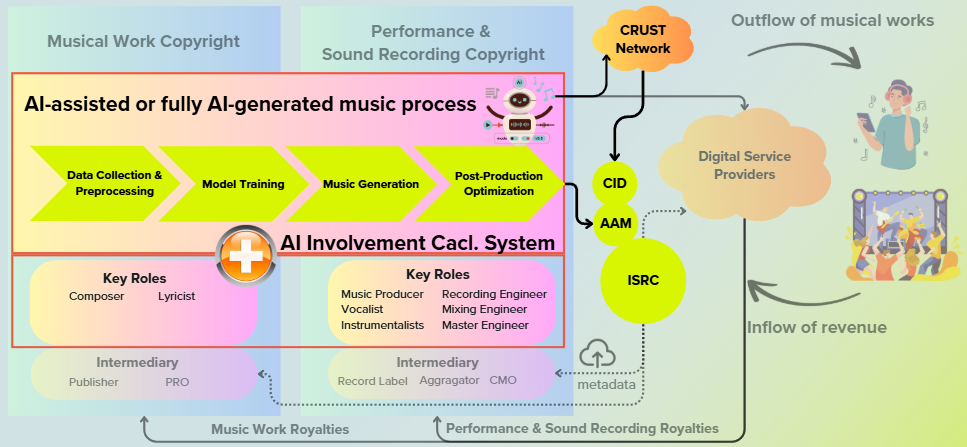
With the rapid advancement of AI technology, AI-generated music has become a significant trend in the music industry. However, the existing music copyright management systems and identification frameworks, such as the ISRC, ISWC, and IPN, were primarily designed for traditional human-created music and do not fully account for the unique attributes of AI-generated music. This chapter proposes a comprehensive AI music management framework, incorporating an AI Music Participation Weight Calculation System, an AAM (AI Application Music) field extension, and a decentralized storage mechanism with CID field to establish the ISRC-AAM-CID next-generation AI music identification system.
The ISRC-AAM-CID AI music identification system accurately differentiates AI-generated music from human-created music, enhances transparency in music copyright management, and optimizes royalty distribution mechanisms. By establishing a standardized AI music system, our goal is to promote fair competition in the AI-driven music industry, protect human creators' rights, and foster the sustainable development of the global music market.
5.1 Establishing an AI Music Participation Weight Calculation System
The objective of this system is to determine the degree of AI involvement in a song by implementing a questionnaire-based mechanism during the music registration process. This enables a clear distinction between AI-generated music and human-created music. The system is structured based on different stakeholders in the music creation, recording, and production process. By incorporating weight distribution for each stakeholder and an AI involvement scoring mechanism, the system calculates an overall AI involvement score (ranging from 0% to 100%). This standardized approach ensures that AI-generated and human-created music can be classified, contributing to a more transparent copyright management system.
5.1.1 Calculation Method
- Weight (Proportion of the Total Work): Based on the copyright distribution logic of the music industry, different entities are assigned different weights (totaling 100%).
| Role | Responsibilities | Weight (100%) |
| Composer | Creates the melody, chords, and rhythm, determining the primary musical direction and style. | 20% |
| Lyricist | Writes the lyrics, conveying the theme, emotions, and narrative of the song. | 15% |
| Music Producer | Oversees recording, arrangement, and vocal/instrumental guidance, ensuring marketability. | 18% |
| Lead Performer/Vocalist | Performs the main vocals, delivering emotional expression and market appeal, directly impacting audience reception. | 15% |
| Instrumentalists / Session Musicians | Play instruments (e.g., guitar, piano, drums), adding depth and arrangement details. | 10% |
| Recording Engineer | Manages the technical aspects of recording, including microphone placement, track management, and sound optimization. | 8% |
| Mixing Engineer | Balances audio tracks, adjusts reverb, and optimizes dynamics to achieve professional sound quality. | 10% |
| Mastering Engineer | Handles final mastering to ensure optimal sound quality across different playback environments. | 4% |
5.1.2 AI Participation Level
- No AI Usage (0%): Entirely created by humans.
- AI-Assisted Composition (50%): AI is used as a supporting tool, but the primary composition is still done by humans.
- Fully AI-Generated Composition (100%): AI is the primary creator, with humans only providing instructions or prompts.
The complete table below:
| Role | Weight (Total 100) | AI Participation Level | AI Tool (Optional) |
| Composer | 20% | ☐ No AI Usage (0%) ☐ AI-Assisted Composition (50%) ☐ Fully AI-Generated Composition (100%) | |
| Lyricist | 15% | ☐ No AI Usage (0%) ☐ AI-Assisted Composition (50%) ☐ Fully AI-Generated Composition (100%) | |
| Music Producer | 18% | ☐ No AI Usage (0%) ☐ AI-Assisted Composition (50%) ☐ Fully AI-Generated Composition (100%) | |
| Lead Performer/Vocalist | 15% | ☐ No AI Usage (0%) ☐ AI-Assisted Composition (50%) ☐ Fully AI-Generated Composition (100%) | |
| Instrumentalists / Session Musicians | 10% | ☐ No AI Usage (0%) ☐ AI-Assisted Composition (50%) ☐ Fully AI-Generated Composition (100%) | |
| Recording Engineer | 8% | ☐ No AI Usage (0%) ☐ AI-Assisted Composition (50%) ☐ Fully AI-Generated Composition (100%) | |
| Mixing Engineer | 10% | ☐ No AI Usage (0%) ☐ AI-Assisted Composition (50%) ☐ Fully AI-Generated Composition (100%) | |
| Mastering Engineer | 4% | ☐ No AI Usage (0%) ☐ AI-Assisted Composition (50%) ☐ Fully AI-Generated Composition (100%) |
For example:
- Composer selects "AI-Assisted Composition" and enters "Suno" as the AI tool.
- Lead Vocalist selects "Fully AI-Generated Vocals" and enters "Udio" as the AI tool.
- Mixing Engineer selects "No AI Usage."
5.1.3 Total AI Participation Calculation
Total AI Score=∑(Role Weight×AI Participation Level)/100
AI Participation Percentage and Definitions:
- 0%: Fully human-created
- 1-20%: Primarily human-created
- 21-50%: Partially AI-assisted
- 51-80%: Deep AI involvement
- 81-100%: Primarily AI-generated
For example:
- Composer: AI-assisted (50%)
- Lyricist: AI-Generated (100%)
- Producer: No AI (0%)
- Lead Vocalist: AI-Generated (100%)
- Instrumentalists: AI-Generated (100%)
- Recording Engineer: No AI (0%)
- Mixing Engineer: AI-assisted (50%)
- Mastering Engineer: No AI (0%)
AI Score Calculation:
(20%×50%)+(15%×100%)+(18%×0%)+(15%×100%)+(10%×100%)+(8%×0%)+(10%×50%)+( 4%×0%) =10%+15%+0%+15%+10%+0%+5%+0%=55%
Final AI Participation: 55%, Deep AI Involvement.
5.1.4 A Unique AI Music Code Based on AI Involvement Level
To effectively distinguish the varying degrees of AI involvement in music creation, it is proposed to establish a unique AI Identification Code (AAM, AI Application Music). This system quantifies AI participation and ensures transparency and standardization within the industry. Based on the level of AI involvement, the classification is divided into five tiers: AAM0 (0%): The music work is entirely human-created, with no AI involvement. AAM1 (1-20%): The music is primarily human-created, with minimal AI assistance. AAM2 (21-50%): AI plays a partial supporting role, such as providing chord progressions or melody suggestions, but the core composition remains human-driven. AAM3 (51-80%): AI takes a dominant role in the creative process, such as automated composition, melody generation, or lyric writing, while humans primarily adjust and refine the output. AAM4 (81-100%): The work is predominantly AI-generated, with minimal human involvement, limited to guidance or minor modifications. This classification system aims to establish a clear framework for identifying AI-generated music, ensuring fair industry practices and accurate copyright management.
| AAM Level | AI Participation Level | Description |
| AAM0 | 0% | Completely human-created, no AI involvement |
| AAM1 | 1-20% | Primarily human-created with minimal AI assistance |
| AAM2 | 21-50% | AI partially assists in creation, such as providing chord progressions or melody suggestions, but core composition remains human-driven |
| AAM3 | 51-80% | AI plays a dominant role in the creative process, such as automatic arrangement, melody generation, or lyric writing, while humans mainly adjust and refine |
| AAM4 | 81-100% | Primarily AI-created, with minimal human involvement, limited to providing guidance or minor modifications |
5.2 Expanding ISRC with AAM to Adapt to AI Music Management Needs
After generating the AAM classification, we propose extending the ISRC code by integrating an AI music identification field. The introduction of the AAM field will help identify AI participation levels, providing a more transparent AI music management mechanism.
Without altering the existing ISRC code structure, AI participation data can be appended as an AAM suffix, forming an ISRC-AAM combination format, as illustrated below:
- Fully Human-Created (AAM0): US-ABC-23-00001-AAM0
- Minimal AI Assistance (AAM1): US-ABC-23-00002-AAM1
- Partial AI Assistance (AAM2): US-ABC-23-00002-AAM2
- Deep AI Participation (AAM3): US-ABC-23-00003-AAM3
- Primarily AI-Generated (AAM4): US-ABC-23-00004-AAM4
This solution will enable streaming platforms, music copyright management agencies, and royalty distribution organizations to more accurately manage and track AI-generated music. Additionally, it will facilitate the future establishment of an AI music database, ensuring market transparency and promoting the sustainable growth of the AI music industry.
5.3 AI Music Decentralized Storage and Blockchain Certification with CID Field
The unlimited scalability of AI-generated music and current regional restrictions pose significant challenges to copyright management. Therefore, it is recommended to adopt a decentralized storage system combined with blockchain certification to ensure the authenticity and ownership of musical works, while also achieving global recognition.
Decentralized storage is essential due to the sheer volume of AI-generated music. Traditional centralized storage is costly and vulnerable to attacks. Decentralized storage solutions like CRUST provide a secure and traceable method to ensure music files remain unaltered and preserved. By integrating smart contracts, storage timestamps, uploader details, and AI involvement metadata can be recorded.
CRUST Network provides an efficient, secure, and traceable storage solution based on IPFS (InterPlanetary File System). Its core advantages include:
- Decentralized Storage with Strong Censorship Resistance: CRUST leverages the IPFS distributed network, ensuring that data is not stored on a single server but is distributed across multiple nodes worldwide, significantly reducing the risk of a single point of failure. Unlike traditional cloud storage providers, CRUST enables tamper-proof storage, ensuring that music files cannot be deleted or modified without authorization, enhancing long-term accessibility of AI-generated music data.
- Data Encryption and Access Control Management: By utilizing smart contracts and encrypted storage mechanisms, CRUST ensures that only authorized users can access specific AI music files, effectively preventing unauthorized access or piracy. Each stored work is assigned a unique CID (Content Identifier). Any modification to the file will result in a new CID, guaranteeing data integrity and traceability.
- Smart Contracts for Copyright Certification and Royalty Distribution: CRUST network supports blockchain-based smart contracts, allowing the system to record storage timestamps, uploader identities, and AI participation levels (AAM classification) for transparent and traceable copyright certification. In the future, smart contracts can automate royalty distribution, ensuring that AI-generated music earnings are allocated according to predefined rules, enhancing fairness and efficiency in the AI music industry.
5.4 Implementing the ISRC-AAM-CID AI Music Identifier
To accommodate the rapid development of AI-generated music, it is recommended to establish a new integrated AI music identifier: ISRC-AAM-CID. This identifier combines existing identifier while incorporating AI-generated work identification and blockchain certification, enabling a comprehensive upgrade in AI music management.
- ISRC-AAM-CID Core Functions:
- ISRC: The International Standard Recording Code, uniquely identifying each recording.
- AAM: AI Application Music classification field, ensuring transparency in AI music identification.
- CID: Blockchain-based Content Identifier, offering decentralized proof-of-authenticity.
- Full AI Music Management Workflow:
- User Registration: Provide AI participation data, metadata, and upload music files.
- Generate ISRC & AAM Classification: Assign ISRC codes with corresponding AAM levels.
- Store Music on Decentralized Network: Secure storage generates a unique CID.
- Blockchain Registration: Secure all metadata via blockchain for transparency and accountability.
- The work is published on streaming platforms for future automated royalty tracking and settlement.
An example of the identifier: us-abc-23-00005-aam3-cidxyz123
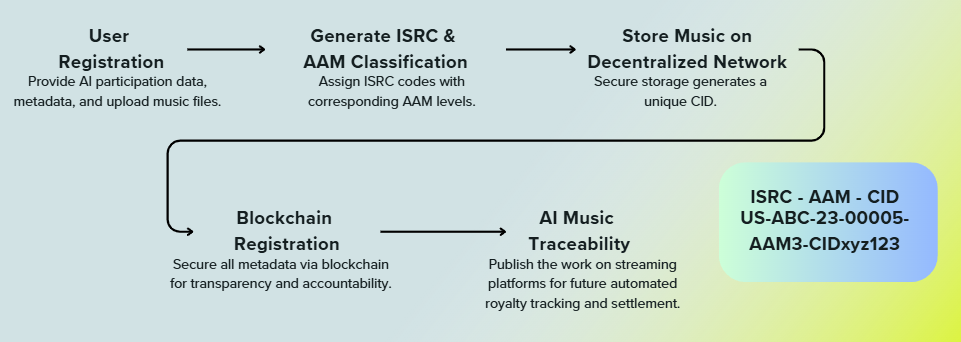
The ISRC-AAM-CID system provides comprehensive support and protection for the music industry in the AI music era, offering several key advantages: Enhancing industry transparency by clearly distinguishing between AI-generated and human-created music; Optimizing royalty distribution based on AI participation levels, ensuring a fair and rational revenue-sharing mechanism; Strengthening music copyright tracking through decentralized storage and blockchain technology, enabling the traceability and secure management of AI-generated music; Promoting fair competition in the global music market by preventing AI-generated music from unfairly manipulating existing industry rules, thereby safeguarding the rights and interests of human creators. This new identifier will help the music industry adapt to the challenges of AI-generated music, fostering a more efficient and fair music ecosystem while providing robust technical and legal support for the future of AI-driven music.
6. The Way Forward
Despite the absence of a unified AI music management standard in the industry, integrating manual reporting with blockchain verification enables the gradual establishment of a transparent, fair, and efficient AI music management system. This system ensures the traceability of AI-generated works and provides a comprehensive industry solution for royalty distribution, copyright ownership, and data storage & management.
6.1 Promoting the ISRC-AAM-CID AI Music Identifier Globally
To ensure standardized AI music management on a global scale, AI-related creation information needs to be incorporated into existing ISRC and even ISWC global music coding systems. Currently, these encoding systems primarily identify music created by humans and lack classification and optimization for AI-generated works. We aim to collaborate with global copyright organizations, promoting adoption by CISAC (International Confederation of Societies of Authors and Composers), IFPI (International Federation of the Phonographic Industry), and ISO (International Organization for Standardization) to standardize AI music encoding and integrate it into existing music copyright databases and royalty distribution systems. At the same time, we will focus on the establishment of technical standards, formulating global AI music recognition protocols to ensure that AI music registration, copyright authentication, and royalty calculations are mutually recognized and compatible across different countries and platforms.
6.2 Establishing an Automated AI Music Classification and Management System
The AI music participation weight system outlined in this white paper provides a short-term solution for identifying AI-generated music, but due to manual reporting, it carries the risk of inaccurate information. To enhance accuracy and efficiency, an automated AI music classification system can be developed based on the AI participation level definition presented here. The core objective of this system is to automatically generate AAM codes based on AI music participation analysis. This will significantly improve AI music recognition speed and accuracy. Furthermore, integrating this system with existing AI music verification technologies, such as melody structure analysis and audio waveform detection, will provide a robust foundation for fair royalty distribution.
6.3 Exploring Blockchain-Based Native AI Music Platforms
As AI music production accelerates exponentially, traditional music copyright registration and centralized database management may struggle to meet the demands of storage and tracking. Blockchain, as a natural vehicle for copyright records, can be leveraged to permanently store AI-generated music creations, playback history, transactions, and royalty payments on a decentralized ledger. This ensures that AI music becomes a Real World Asset (RWA) on-chain, allowing for more efficient copyright registration, rights management, royalty distribution, and secure storage.
6.4 Collaboration with Legal and Policy Makers
The rise of AI music has also introduced a series of legal and policy challenges, including AI-generated content ownership, royalty calculations, and data transparency. Moving forward, we will be focused on developing a legal framework for AI music by working with government agencies, copyright organizations, and legal experts to establish AI music copyright protection mechanisms that define ownership of AI-generated works; formulating industry guidelines that outline data sources, copyright declaration requirements, and royalty distribution rules to ensure compliance and legitimacy of AI-generated music, and advancing international copyright recognition by aligning AI music-related copyright laws across different jurisdictions. This will help prevent copyright disputes arising from regulatory differences between regions.
6.5 Future Outlook
AI music is reshaping the global music industry, but its development comes with significant challenges. By establishing the ISRC-AAM-CID identification framework, the music industry can achieve greater fairness and transparency in copyright management in the AI era. As AI technology continues to evolve, AI-generated music will not only serve as a creative tool but also become an integral part of the music ecosystem. The global adoption of AI music standards will help protect creators' rights while fostering sustainable AI-driven music innovation.
Ultimately, AI music management should not be limited to technological solutions—it requires a multidisciplinary approach, encompassing legal, market, and ethical considerations. Through international cooperation, industry standardization, and technological innovation, we can build a healthier and fairer ecosystem for the music industry in the AI era.