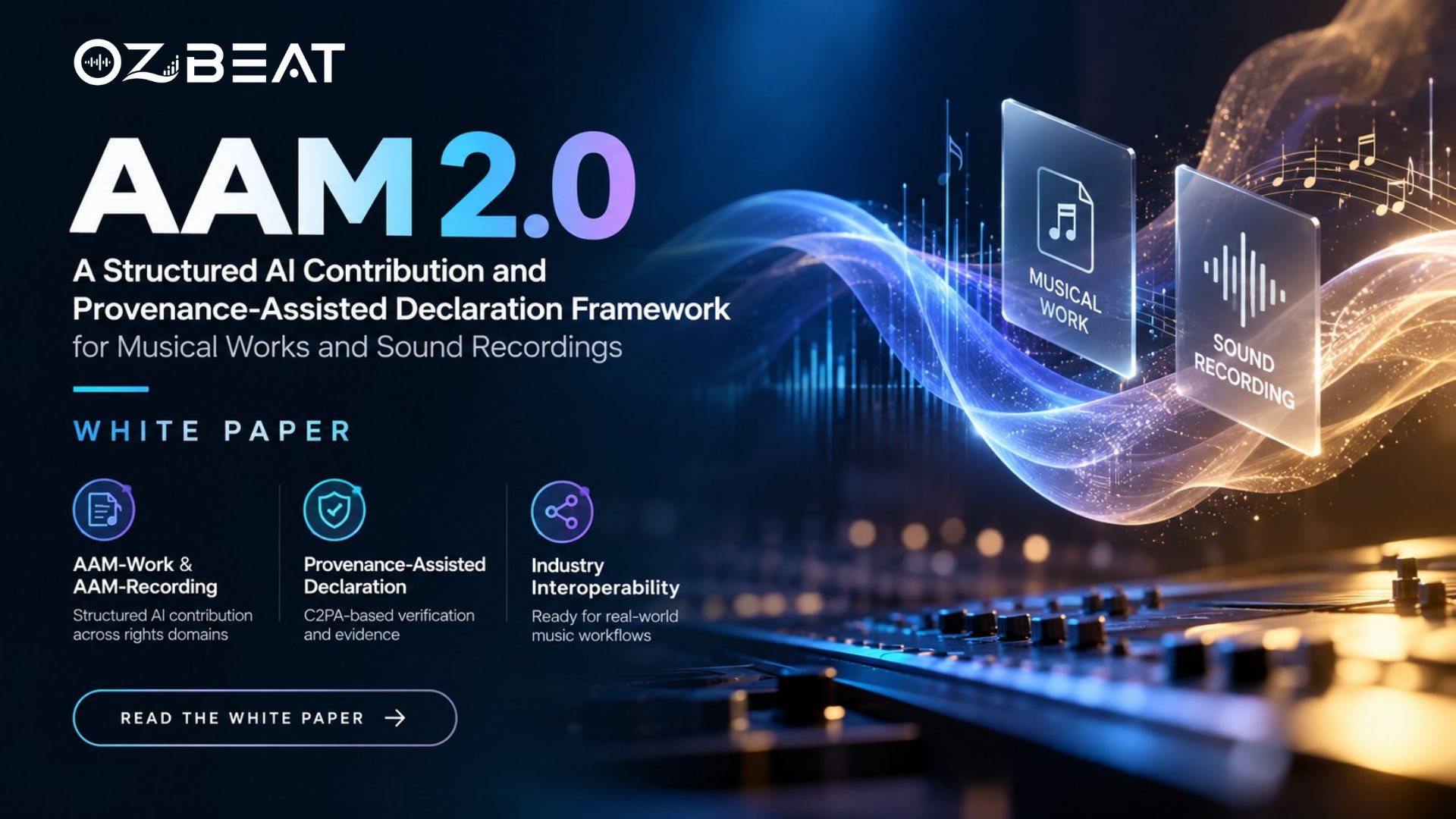
Sydney, Australia — September 2026 — OZBeat AI has officially released the AAM 2.0 White Paper, introducing an updated framework for describing and measuring how generative AI contributes to the creation of music.
Titled “A Structured AI Contribution and Provenance-Assisted Declaration Framework for Musical Works and Sound Recordings,” AAM 2.0 builds on the practical experience of AAM 1.0 and more than 1,600 registered songs, moving beyond a single measure of overall AI involvement toward a more structured, rights-aware approach.
At the centre of AAM 2.0 is a fundamental distinction already embedded in the music industry: the separation between the Musical Work and the Sound Recording.
Under the new framework, AI contribution can be expressed independently through AAM-Work and AAM-Recording. Creative roles such as composition and lyrics are represented at the Musical Work level, while production, vocals, instrumentation, recording, mixing and mastering are represented at the Sound Recording level.
This allows AAM to address a growing challenge created by generative AI. Modern AI music systems can compress composition, lyrics, performance and production into a single generation process, making traditional contribution relationships increasingly difficult to observe. AAM 2.0 provides a structured way to make those contributions visible again.
The framework introduces three key developments:
- Dual-domain AI contribution measurement — separating Musical Work and Sound Recording while keeping them connected within the same AAM framework.
- Role-level AI declaration — describing AI participation through specific Creative Roles rather than relying only on broad labels such as “AI-generated” or “AI-assisted.”
- Provenance-Assisted Declaration — allowing available C2PA-compatible provenance information to support and inform AAM declarations without treating provenance as a substitute for contribution data.
AAM 2.0 also places greater emphasis on industry interoperability. Existing identifiers remain unchanged: ISWC continues to identify the Musical Work and ISRC continues to identify the Sound Recording. AAM operates as an additional AI Contribution Layer, designed so that relevant information can be associated with existing music entities and exchanged through industry workflows, including potential DDEX-compatible implementations.
The release follows OZBeat AI’s participation in the DDEX AI Working Group meeting in Nashville in September 2026, where OZBeat presented its work on structured AI music disclosure alongside other music-technology organisations. Discussions around granular generative-AI declarations, Musical Work and Sound Recording data, provenance, attribution and interoperability have further informed the direction of AAM 2.0.
AAM 2.0 maintains a clear technical boundary. It does not determine authorship, copyright ownership, infringement or royalty entitlement, and it does not replace ISWC, ISRC, DDEX or C2PA. Instead, it focuses on a specific information problem:
Where did AI contribute to the music, in which creative role, and to what degree?
The next phase will focus on operational testing of AAM-Work and AAM-Recording, C2PA-compatible provenance workflows, and interoperability with creators, publishers, labels, distributors, DSPs, rights organisations, AI companies and music-industry standards initiatives.
As generative AI becomes increasingly integrated into music creation, the industry needs to move beyond simply identifying whether AI was used. AAM 2.0 provides a framework for describing how AI contributed to the resulting music in a form that can be declared, measured and exchanged.