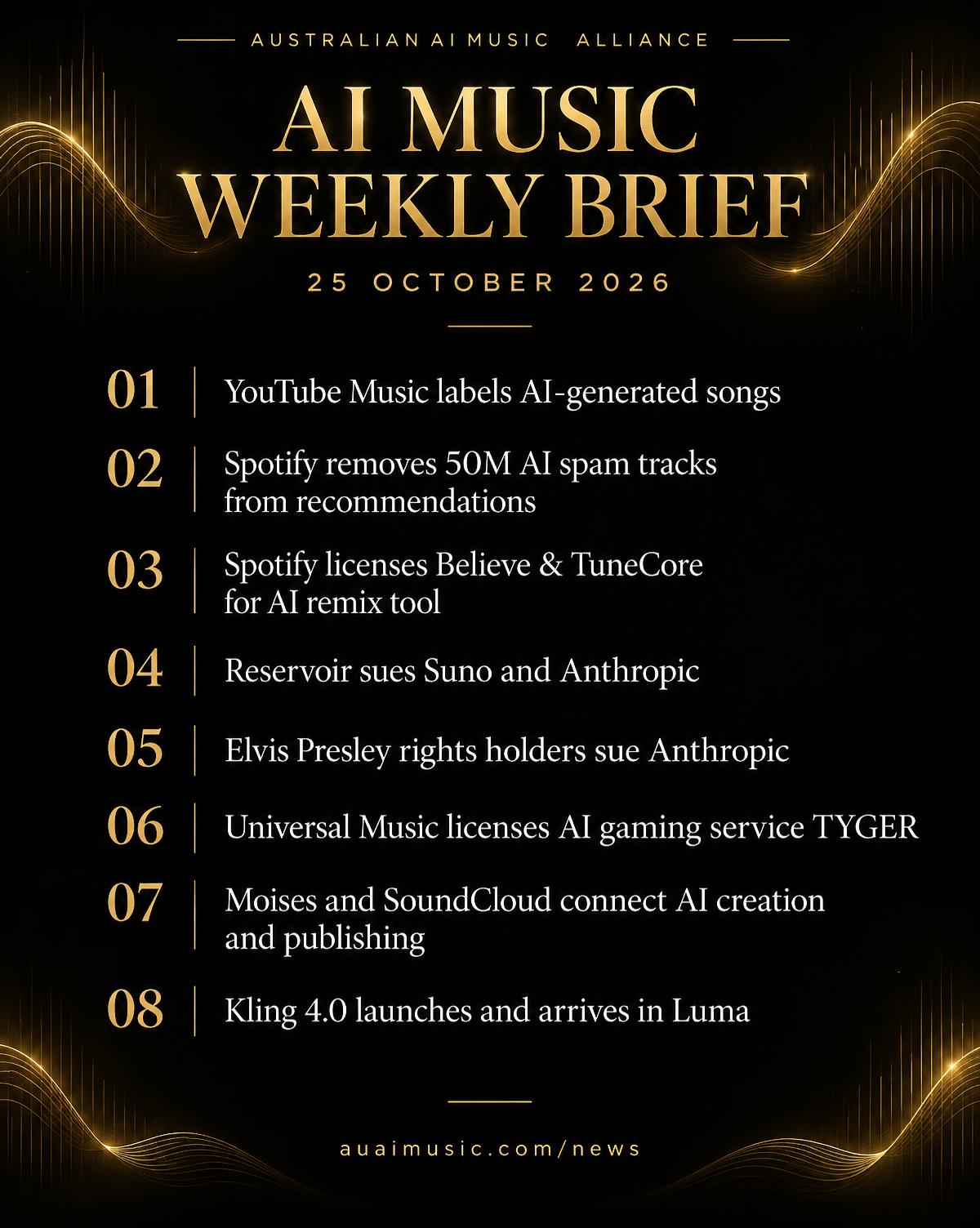
1. YouTube Music starts labelling AI-generated songs
On 14 October, YouTube Music began showing a label on the player page when a song was created primarily with generative AI — for example, when a model produced both the composition and the vocals. Tapping the label shows more information. YouTube says it is working with music partners and its own detection tools to identify these tracks, and the labels will expand to the main YouTube app. This makes YouTube one of the first major platforms to label AI music at the track level, a clear signal that AI disclosure is becoming standard practice for distribution.
2. Spotify removes 50 million AI "slop and spam" tracks from recommendations
In a one-year update published on 20 October, Spotify said it has taken more than 50 million low-quality AI and spam tracks out of recommendations this year, on top of 75 million spam tracks removed from the platform entirely. It combines listener feedback, upload patterns, metadata and several third-party AI detection tools, while admitting detection alone is unreliable. Spotify also uses an "AI Persona" badge for artist profiles that do not represent a real person, but does not yet require labels on individual AI songs.
3. Spotify licenses Believe and TuneCore for its AI remix tool
Spotify signed a licensing deal with Believe, covering its distribution arm TuneCore, for an upcoming AI tool that will let fans remix or cover songs inside Spotify. It follows earlier deals with Universal Music Group, Merlin and Kobalt. The tool is planned as a paid add-on to Premium and has no release date yet. Artist participation is voluntary: artists first choose whether to join, then whether Spotify may use their work. Believe framed the deal around consent, control, compensation and transparency.
4. Reservoir sues Suno and Anthropic over training data
Independent music company Reservoir filed lawsuits against AI music generator Suno and AI company Anthropic, accusing both of copying more than a thousand of its compositions to train their models without permission. The catalogue named includes songs by Joni Mitchell, Johnny Cash and Madonna. The case adds to a growing list of legal actions over how AI models are trained, and shows that rights holders are now targeting general-purpose AI companies as well as dedicated music generators.
Source: Music Business Worldwide
5. Elvis Presley's rights holders sue Anthropic
On 23 October, entities controlling Elvis Presley's music, led by Authentic Brands Group, sued Anthropic, alleging it trained its AI on 274 of his copyrighted songs without permission, including "Can't Help Falling in Love" and "Don't Be Cruel". Billboard called it the most high-profile AI lawsuit filed on behalf of an individual artist so far. The case raises the stakes for AI companies and is likely to increase pressure for licensed, documented training data in the music industry.
6. Universal Music licenses TYGER, an AI gaming music service
Universal Music Group became the first major label to license TYGER, a San Diego service that uses AI to adapt licensed songs to live gameplay in real time. Selected UMG recordings and songs will be available on TYGER's paid subscription, with some on its free ad-supported tier. TYGER works across PC, console and mobile without game studios needing to integrate it. The deal is an example of licensed AI music use creating new revenue for artists rather than replacing them.
Source: Music Business Worldwide
7. Moises and SoundCloud connect AI creation with publishing
AI music suite Moises, used by about 80 million musicians, partnered with SoundCloud on 21 October. Artists can bring SoundCloud tracks into Moises, use AI tools such as stem separation, chord and lyric detection, mixing and mastering, and its production assistant "Moi", then publish the finished work straight back to SoundCloud. Both companies present the tools as supporting human creativity rather than replacing it, giving more than 150 million artists a single path from creation to release.
8. Kling 4.0 launches and arrives in Luma
Kuaishou launched Kling 4.0, its new AI video model, on 15 October. It focuses on realism and control: steadier fast motion and complex camera moves, up to 30 seconds generated in a single pass, and "Omni Reference" combining up to 15 reference assets and 10 keyframes. On 23 October Luma added Kling 4.0 for all its customers. For music creators, longer and more controllable AI video makes it easier and cheaper to produce music videos and visual content for releases.