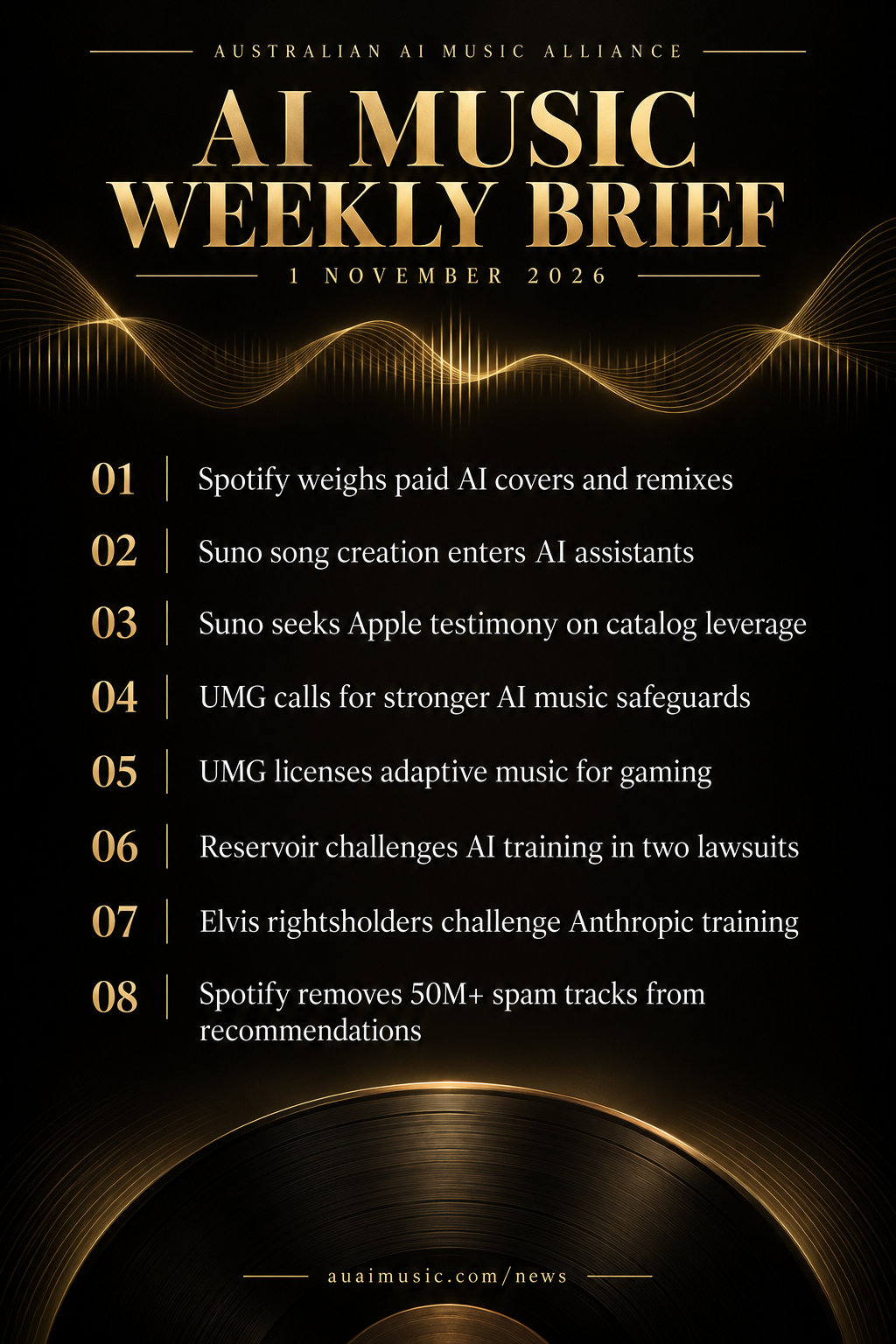
1. Spotify reportedly targets Q1 2027 for AI covers tool
Spotify plans to launch its AI-powered covers and remixes tool in the first quarter of 2027, according to a Financial Times report cited by Music Business Worldwide. The October 30 report, attributed to people familiar with the plans, said Spotify is weighing a monthly price of $4–$5 for the tool. Both the timing and pricing remain reported plans rather than a confirmed launch announcement. For the music industry, the proposal points to a potential paid use of AI centered on covers and remixes, with the eventual price and release schedule still important unknowns.
Source: musicbusinessworldwide.com (2026-10-30)
2. Suno brings song creation into AI assistants
Suno has unveiled Suno MCP, a beta tool that lets users create songs inside AI assistants including ChatGPT, Claude and Gemini. The company announced the tool in release notes published on October 28. Separately, Music Business Worldwide spotted a sign-in portal for Suno’s developer API, which Suno said also remains in beta. The developments extend access to Suno beyond a standalone music-generation workflow, bringing song creation into general-purpose AI conversations. For the music industry, they highlight another distribution route for generative music tools, while both offerings remain at the beta stage.
Source: musicbusinessworldwide.com (2026-10-30)
3. Suno seeks Apple testimony on major-label licensing
Suno is seeking testimony from Apple about whether Apple Music could survive without Universal Music Group and Sony catalogs. It claims the majors use their catalogs as leverage to secure anti-AI concessions. Suno also wants an Apple witness to address the company’s current licensing negotiations with both majors and streaming fraud on Apple Music. The request puts catalog bargaining power, AI-related licensing conditions and platform fraud into the same dispute. These are issues affecting relationships between music rightsholders, streaming services and AI developers; the report describes Suno’s demands and claims, not established findings.
Source: musicbusinessworldwide.com (2026-10-30)
4. UMG presses streaming services for stronger AI safeguards
Universal Music Group used its quarterly earnings call to press streaming services for stronger action on fully AI-generated music. CEO Lucian Grainge cited Deezer figures indicating more than 90,000 such tracks are uploaded daily and said safeguards were falling behind. He called for clearer labeling and enforcement of contractual protections, while challenging equal payment treatment for unethically generated tracks. UMG reported third-quarter revenue of €3.39 billion, up 12.3% year on year, including Downtown Music. The comments connect AI content controls with streaming payment policy, as UMG argues that growing volumes and fraud threaten compensation for artists and rightsholders.
Source: musically.com (2026-10-30)
5. UMG licenses music to adaptive gaming platform Tyger
Universal Music Group has become the first major music company to license its repertoire to Tyger, a platform that adapts music in real time to supported games. Selected content from UMG’s recorded-music and publishing catalogs will become available through Tyger’s paid subscription service, with some recordings also offered on its free, ad-supported tier. Tyger is already live with more than 400,000 songs, mainly from independent artists, and plans a relaunch later this year. The agreement creates a licensed route for artists and songwriters to reach gaming audiences through personalized listening alongside existing games.
Source: digitalmusicnews.com (2026-10-23)
6. Reservoir sues Suno and Anthropic over AI training
Reservoir Media has filed separate copyright infringement and DMCA lawsuits against Suno and Anthropic in the Northern District of California. It alleges Suno trained on protected music without permission and argues that Suno’s licensing agreements with other music companies demonstrate a functioning market for training licenses. Reservoir also seeks $2.63 million for alleged access-control circumvention and $26.25 million for alleged removal of copyright management information in the Suno case. Its Anthropic complaint concerns 853 works. The cases add pressure on AI developers over training permissions, fair use and copyright metadata, with the allegations still to be adjudicated.
Source: digitalmusicnews.com (2026-10-22)
7. Elvis rightsholders sue Anthropic over 274 songs
An Authentic Brands Group subsidiary and other companies with interests in Elvis Presley’s music sued Anthropic on October 23. They allege the company used 274 Presley-associated songs, including “All Shook Up” and “Can’t Help Falling in Love,” to train AI models without permission, and that those models can generate unauthorized versions. The plaintiffs seek statutory damages of up to $150,000 per song, approximately $41.1 million altogether. Anthropic had not publicly addressed this lawsuit, but has defended copyrighted-material training under fair use. The case expands music-rightsholder litigation over AI training licenses and allegedly infringing outputs.
Source: digitalmusicnews.com (2026-10-26)
8. Spotify excludes over 50 million spam tracks from recommendations
Spotify says it has excluded more than 50 million tracks identified as slop or spam from recommendations during 2026. Its update also repeated that over 75 million spam tracks had been removed from the platform, but that figure was already disclosed in September 2025; Spotify did not provide a fresh takedown total. The company said recommendation changes reduced listener concerns and highlighted AI Credits, AI Persona badges and roughly 300,000 verified artists. The distinction between recommendation exclusion and removal matters for assessing enforcement, as Spotify balances content quality, artist visibility and its forthcoming AI remix and cover tool.