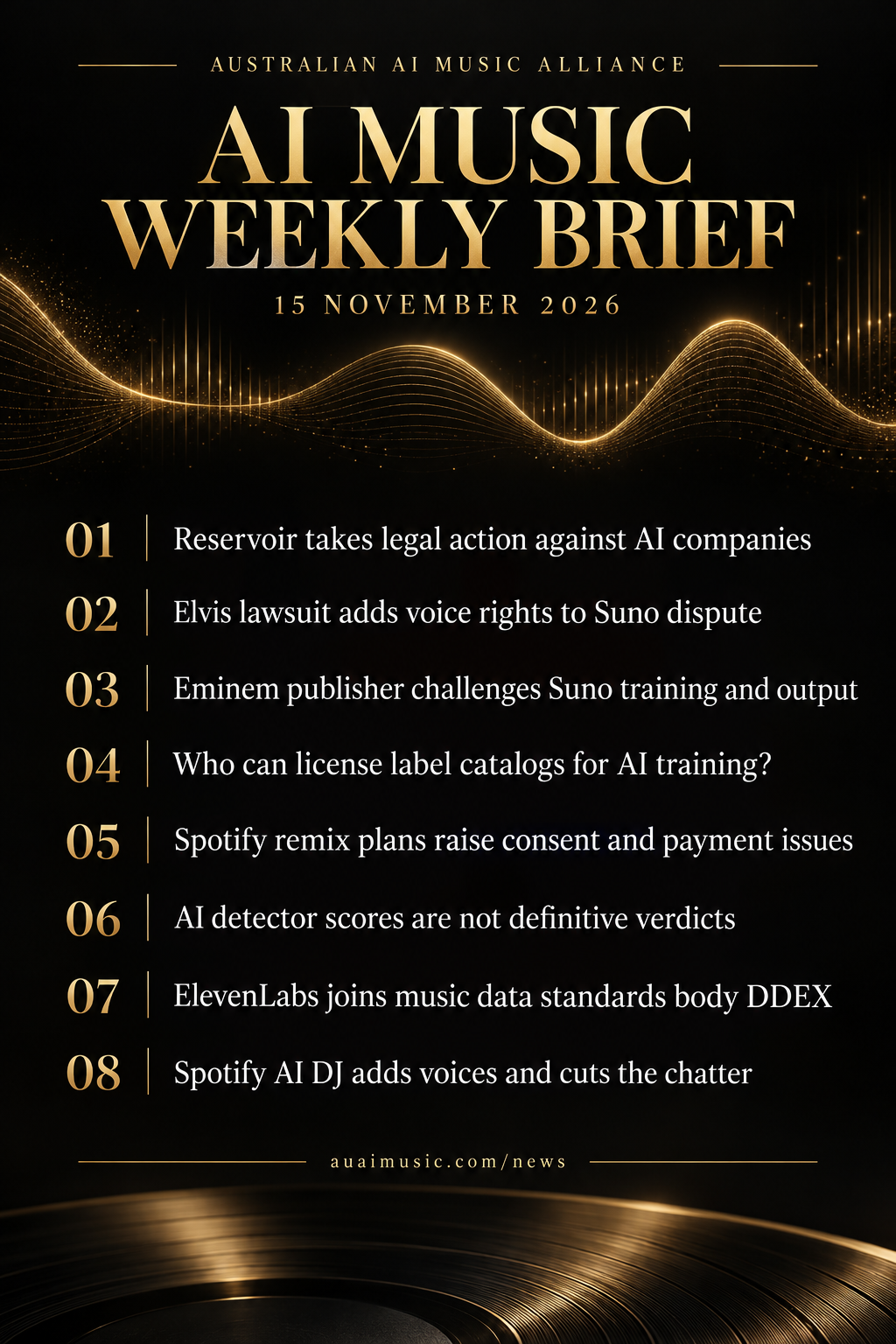
1. Reservoir lawsuits target Suno and Anthropic
Reservoir first sued Suno and Anthropic in October, according to the supplied RSS summary published on November 13. The summary identifies the two AI companies and the timing of the initial lawsuits, but offers no further details about the claims, requested remedies or responses from the defendants. For the music industry, the reported litigation places Reservoir among the companies pursuing legal action against AI businesses. The limited source material does not establish the merits or outcome of either case, so broader conclusions about liability or licensing consequences would be premature.
Source: musicbusinessworldwide.com (2026-11-13)
2. Elvis rightsholders sue Suno over copyright and likeness
Elvis Presley Enterprises, Raleigh Music Publishing and an Authentic Brands Group subsidiary have sued Suno in California federal court. The plaintiffs allege unauthorized training, infringing outputs and synthetic uses of Presley’s voice and likeness. Their claims cover 859 works and seek more than $152 million based on maximum statutory damages for alleged copyright and DMCA violations. They also invoke Tennessee’s ELVIS Act and common-law publicity rights. The complaint argues that Suno’s licensing agreements demonstrate a market for authorized training. The case brings artist identity protections alongside copyright into the dispute over AI music; the allegations are not court findings.
Source: digitalmusicnews.com (2026-11-09)
3. Eight Mile Style sues Suno over 269 compositions
Eminem’s publisher Eight Mile Style has sued Suno in the Northern District of California, alleging that it trained AI models on 269 compositions without permission or compensation. The complaint cites alleged scraping of music and lyrics and includes an example said to reproduce the lyrics of “Lose Yourself” verbatim. Suno says it prohibits unauthorized use, blocks prompts naming specific artists and songs, and uses third-party screening for uploaded audio and lyrics. The lawsuit links allegations about training inputs to generated outputs, making both licensing authorization and the effectiveness of safeguards central issues for music rightsholders and AI platforms.
Source: digitalmusicnews.com (2026-11-09)
4. Suno discovery dispute examines labels’ AI training rights
A roughly 80-minute discovery conference in the majors’ litigation against Suno examined whether Universal Music and Sony Music have contractual rights to license recordings for AI training. Counsel noted that older artist agreements, including Sony contracts dating to the 1980s, do not anticipate AI and require interpretation. UMG executive Jonathan Dworkin is set to supplement testimony on Spotify’s AI detection and tracking disclosures. Discussions also covered financial data and concessions tied to anti-dilution provisions in streaming agreements. The dispute matters because prospective AI licenses depend not only on commercial terms but also on what rights labels actually control.
Source: digitalmusicnews.com (2026-11-11)
5. Spotify’s planned AI remix tool draws criticism
Spotify’s AI remix tool, scheduled for early next year, is drawing online criticism over training ethics, artist compensation and demand for more AI features. Listeners would be able to alter songs, including their style or vocalist, but remixes would remain inside Spotify. The company has agreements with Universal Music Group, Merlin, Believe and Kobalt; individual artists would choose whether to participate. Some users say they may leave the service. Industry questions remain about backing musicians’ consent and payment, credits, royalty allocation and publisher notification, highlighting that artist opt-in alone does not resolve every rights issue surrounding derivative music.
Source: digitalmusicnews.com (2026-11-09)
6. Disputed AI detector results highlight risks for artists
Hamburg musician André Grafet says his 23-track Colored Tears release used no generative AI, yet SubmitHub’s detector classified every track as mostly AI or hybrid. Tests of older Twice a Man recordings produced different results depending on whether YouTube or Spotify links were used. SubmitHub disputes criticism, citing a UMG-commissioned test reporting 99.3% accuracy and explaining that scores express confidence, not the proportion of AI content. A separate peer-reviewed study found 4.7% false alarms for another commercial detector. With no independent production files published to settle Grafet’s case, the dispute highlights the risks of treating probabilistic scores as definitive platform decisions.
Source: digitalmusicnews.com (2026-11-09)
7. ElevenLabs becomes DDEX’s first AI company member
ElevenLabs has joined Digital Data Exchange, or DDEX, as a full member, becoming the standards organization’s first AI company member. DDEX has more than 150 members across music and technology and develops standards for exchanging industry data. ElevenLabs plans to participate in plenaries and working groups addressing music communication, including AI-related issues. Membership gives companies a role in shaping standards, although implementing DDEX standards does not require joining. The move brings an AI developer into the industry’s shared data infrastructure discussions, where operational requirements and the communication of information across the music value chain are central.
Source: digitalmusicnews.com (2026-11-06)
8. Spotify adds AI DJ voices and optional commentary
Spotify began rolling out additional AI DJ voices on November 10 to Premium subscribers in supported markets. Alongside the default DJ “X,” users can choose seven new English voices and two Spanish options, each with a distinct personality. A new toggle switches off between-song commentary, although brief acknowledgments remain when starting the DJ or changing the vibe. Spotify says more than 94 million Premium listeners have used AI DJ and 80% return in subsequent weeks. Available across more than 95 markets, the feature illustrates the scale of AI-powered listening personalization, with this update emphasizing user control and fewer interruptions.