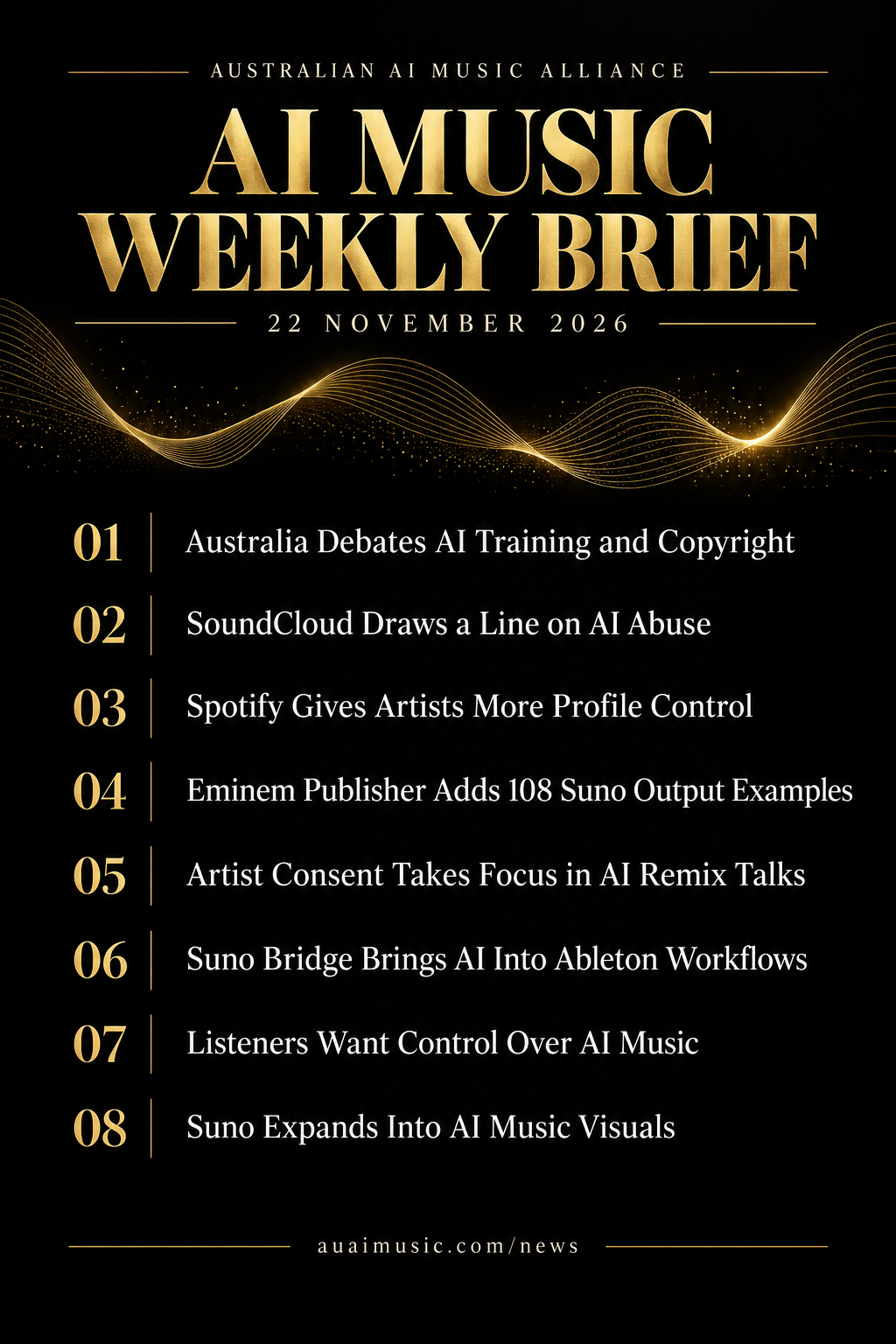
1. Australian Creative Sector Opposes AI Training Plans
Australia’s creative sector is pushing back against plans to permit AI training, with the music industry warning that weaker copyright protections could affect rightsholders worldwide. Music Ally reports that the industry has clearly opposed efforts by AI companies to persuade the Australian government to relax protections around model training. The available report does not detail the proposed permit mechanism or any government decision. The dispute matters beyond Australia because the industry sees the potential consequences as global: changes to copyright safeguards for training could affect how music rightsholders’ interests are protected as AI development expands.
Source: musically.com (2026-11-20)
2. SoundCloud Tightens Rules on AI Abuse and Mass Uploads
SoundCloud has launched a crackdown on AI slop, spam and excessive uploads, announced by CEO Eliah Seton alongside updated platform rules. Its terms prohibit using AI to manipulate earnings, deceive listeners about authenticity or misrepresent a creator’s identity. Community guidelines also target near-duplicate tracks, artificially inflated plays, infringing uploads and deepfakes. Enforcement options include upload limits, additional review and withholding, reversing or recovering payouts. SoundCloud retains discretion over what constitutes excessive uploading. The changes seek to protect discovery and artist earnings while the company continues pursuing AI opportunities, including recent partnerships with ElevenMusic and Moises.
Source: digitalmusicnews.com (2026-11-18)
3. Spotify Rolls Out Artist Profile Protection
Spotify is rolling out Artist Profile Protection to all artists, eight months after announcing a beta with selected participants. Through Spotify for Artists, musicians can receive alerts when releases are submitted under their name, review them and remove their association with music that is not theirs. Spotify says thousands of artists helped refine the tool during testing without disrupting release schedules. The rollout follows a report that Sony Music requested removal of more than 260,000 deepfake tracks from digital platforms. For the industry, the feature addresses content mismatches and impersonation by giving artists more direct control over their profiles.
Source: digitalmusicnews.com (2026-11-17)
4. Eight Mile Style Expands Copyright Suit Against Suno
Eminem publisher Eight Mile Style has amended its copyright and DMCA lawsuit against Suno, adding 108 examples of allegedly infringing outputs involving 26 works. The publisher alleges that Suno scraped 269 Eminem works for model training and enabled unauthorized derivative outputs, some allegedly mimicking his voice. Its combined statutory damages demand remains $47.8 million, unchanged from the original complaint. The added examples include versions of “Without Me,” “The Real Slim Shady” and “Lose Yourself” that allegedly incorporate protected lyrics. The case puts both training practices and generated outputs under scrutiny, with potential financial consequences for AI music businesses.
Source: digitalmusicnews.com (2026-11-20)
5. Spotify and WMG Discuss Artist Consent for AI Remixes
Spotify’s upcoming AI remix tool featured in discussions at the Morgan Stanley European Technology, Media and Telecom Conference and Warner Music Group’s quarterly earnings call. Spotify chief financial officer Christian Luiga appeared at the conference, while WMG addressed the topic in its earnings discussion. Music Ally identified artist consent as the notable issue across both appearances. The available report does not specify consent procedures, commercial terms or a launch date. For the music industry, the discussions put artist permission at the center of how AI remix products are being considered by a major streaming service and label group.
Source: musically.com (2026-11-20)
6. Suno Bridge Beta Connects to Ableton Live 12 on Mac
Suno has introduced Bridge, a standalone application that brings its music models into producers’ digital audio workstation workflows. The beta supports Ableton Live 12 on Mac, with additional operating systems and DAWs planned. Users can generate instrument and vocal parts and place them directly on their session timeline. Suno says the sounds follow existing chord progressions, groove and key, while allowing producers to retain their plugins and audio routing. The launch extends generative AI into established production environments rather than requiring a separate creative workflow. It also comes as Suno and its partners face major copyright infringement lawsuits.
Source: digitalmusicnews.com (2026-11-17)
7. UMG Says Over 80% of US Consumers Want AI Music Filters
Universal Music Group executive Michael Nash says new company research finds more than 80% of US consumers want the option to exclude all AI-generated music from listening. Earlier UMG surveys put support at 74% in the US and 68% globally. Separately, Deezer reports that 41% of surveyed listeners prefer filtering out AI music entirely. Deezer also found that 74% of surveyed streaming users believed their playlists contained none, while separate internal data showed nearly 57% of more than 53,000 October arrivals had at least one fully AI-generated track. The findings highlight demand for transparency and listener controls, although the datasets are distinct.
Source: digitalmusicnews.com (2026-11-20)
8. Suno Launches Visuals for AI Music Images and Videos
Suno has launched Visuals, a web tool for creating images and video clips of up to 15 seconds to accompany Suno-generated songs. Uses include lyric videos and album art, with iOS and Android apps planned in the coming weeks. Suno says clips can follow song structure, respond to lyrics and lip-sync. Users can select characters or upload images, then edit through text prompts. The company describes filters against representations of specific artists, public figures and protected intellectual property, plus checks before outputs reach users. The launch expands Suno into music visuals while copyright disputes keep safeguards and licensing central to its business.