
Music copyright refers to the legal framework that protects musical works and sound recordings, ensuring that creators, performers, and recording producers receive their rightful benefits and income. In the music industry, copyright is primarily divided into two core categories: Musical Work Copyrights and Performance & Sound Recording Copyrights. These two types of copyrights cover different aspects of music creation and grant various economic and control rights to the respective rights holders.
Musical Work Copyrights
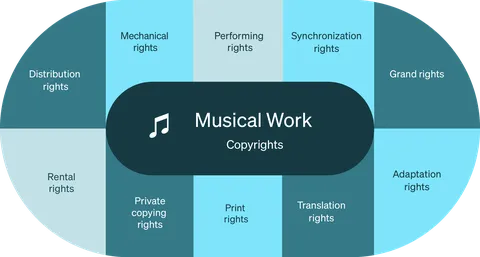
Musical Work Copyrights refer to the legal protection of song composition, including the melody, chords, lyrics, and overall structure of a musical work. This type of copyright applies to songwriters (composers and lyricists) and music publishers, ensuring that they receive appropriate financial compensation when their works are used.
Musical Work Copyrights grant the rights holders the following key rights:
- Mechanical Rights: This refers to the right to reproduce a musical work on physical or digital media, such as CDs, vinyl records, digital downloads, and streaming platforms. It applies to record labels, streaming services, and digital music stores (such as iTunes), which are required to pay mechanical royalties to obtain the necessary licenses for reproduction.
- Performing Rights: This refers to the right to play or perform a musical work in public, including live performances, radio broadcasts, television broadcasts, and streaming services. It applies to restaurants, shopping malls, TV stations, radio stations, concert venues, and streaming platforms (such as Spotify and Apple Music). These entities are required to pay performance royalties for the use of the music.
- Synchronization Rights: This refers to the right to use a musical work in synchronization with visual content, such as films, advertisements, video games, and television shows. It applies to film production companies, advertisers, game developers, and other media creators, who must pay synchronization license fees to use the music in their productions.
- Grand Rights: This refers to the right to use a musical work in connection with theatrical productions, such as operas, musicals, stage plays, and ballet performances. It applies to theater productions, Broadway musicals, ballet performances, and similar staged works. Typically, the producers of the theatrical performance must pay licensing fees to the songwriters or music publishers for the use of the music in their production.
- Adaptation Rights: This refers to the right to modify, translate, arrange, or rearrange an original musical work. It applies to remixes, cover versions, re-arranged compositions, and re-recorded versions. Permission from the original songwriters and the music publishing company is required before making any adaptations.
- Translation Rights: This refers to the right to translate song lyrics from one language to another. It applies to international music market distribution, such as translating an English pop song into Spanish, French, or other languages. Permission from the original songwriters and the music publishing company is required for such translations.
- Print Rights: This refers to the right to authorize the printing and sale of sheet music for a musical work. It applies to sheet music publishing, educational materials, and music books. Publishers are typically required to pay print royalties to the songwriters and music publishing companies for the reproduction and distribution of sheet music.
- Private Copying Rights: This refers to the right of users to make copies of a musical work for personal use in a private setting, such as at home. It typically involves the collection of compensation fees to account for potential revenue loss to rights holders. This applies to personal music collections, copying between devices, and other private-use scenarios.
- Rental Rights: This refers to the right to distribute a musical work through rental services. It applies to karaoke establishments, music libraries, and rental companies, which are required to pay licensing fees to the songwriters and music publishing companies for the right to rent out the music.
- Distribution Rights: This refers to the right to distribute a musical work to the public in physical or digital formats. It applies to CDs, vinyl records, digital downloads, and streaming platforms. Distributors must obtain authorization from the songwriters or music publishing companies before distributing the music.
Performance & Sound Recording Copyrights
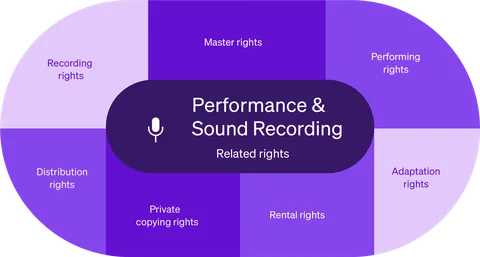
Performance & Sound Recording Copyrights refer to the legal protection of music recordings (i.e., a specific recorded version of a song) and the rights of performers. These rights ensure that recording producers (record labels) and performers (singers, bands, musicians) receive economic benefits from the use of their recordings.
- Recording Rights: This refers to the legal protection of a specific recorded version of a song, ensuring that unauthorized reproduction or distribution does not infringe upon the rights of the recording producer. It applies to record labels and recording producers, helping to prevent piracy and unauthorized distribution.
- Master Rights: This refers to the control over the final master recording, determining how the recording can be used, modified, and commercialized. It applies to record labels and producers, with record labels typically holding ownership of the master recording.
- Performing Rights: This refers to the right to publicly play or perform a sound recording, including radio broadcasts, streaming services, and background music in public venues. It applies to concert venues, streaming platforms, and radio stations, which are required to pay performance royalties to recording producers and performers.
- Adaptation Rights: This refers to the right to modify a sound recording through remixing, editing, pitch shifting, or other alterations. It applies to remixes, re-recordings, edited versions, and rearranged versions, requiring authorization from the recording producer and the performers.
- Rental Rights: This refers to the right to rent out sound recordings to the public. It applies to DVDs, vinyl records, karaoke venues (KTV), and music rental stores, which are required to pay licensing fees to the recording producers and performers for the right to rent the recordings.
- Distribution Rights: This refers to the right to distribute sound recordings in physical or digital formats. It applies to CDs, digital music, streaming platforms, and other distribution channels. Record labels or authorized agencies manage the distribution process and receive revenue from the distribution of the recordings.
- Private Copying Rights: This refers to the right that allows individuals to store and copy music recordings for personal use in a private setting (such as at home). It applies to music stored on personal devices, and is often linked to a private copying compensation system, where levies or fees may be collected to compensate rights holders for potential revenue loss due to private copying.
The music copyright system encompasses two core areas: Musical Work Copyrights and Performance & Sound Recording Copyrights. It provides legal protection and economic benefits to songwriters, performers, recording producers, and music distributors. These rights ensure that throughout the processes of creation, recording, distribution, performance, and adaptation, rights holders receive fair compensation and that their creative efforts are properly recognized and protected.
With the rise of the digital music era, the music copyright system is facing new challenges, including the streaming economy, cross-border copyright management, AI-generated music (AI Music), NFT-based ownership, and blockchain-based copyright registration. Balancing the protection of creators' rights while fostering innovation in the music industry has become a shared concern for global copyright management organizations, record labels, streaming platforms, and creators. In the future, a standardized copyright management system, intelligent royalty distribution models, and transparent music data tracking mechanisms will be key directions for the further development and refinement of the music copyright system.