A perspective from ozbeat.ai and the Australian AI Music Alliance on what the new DDEX standard means, and where it still needs to go.
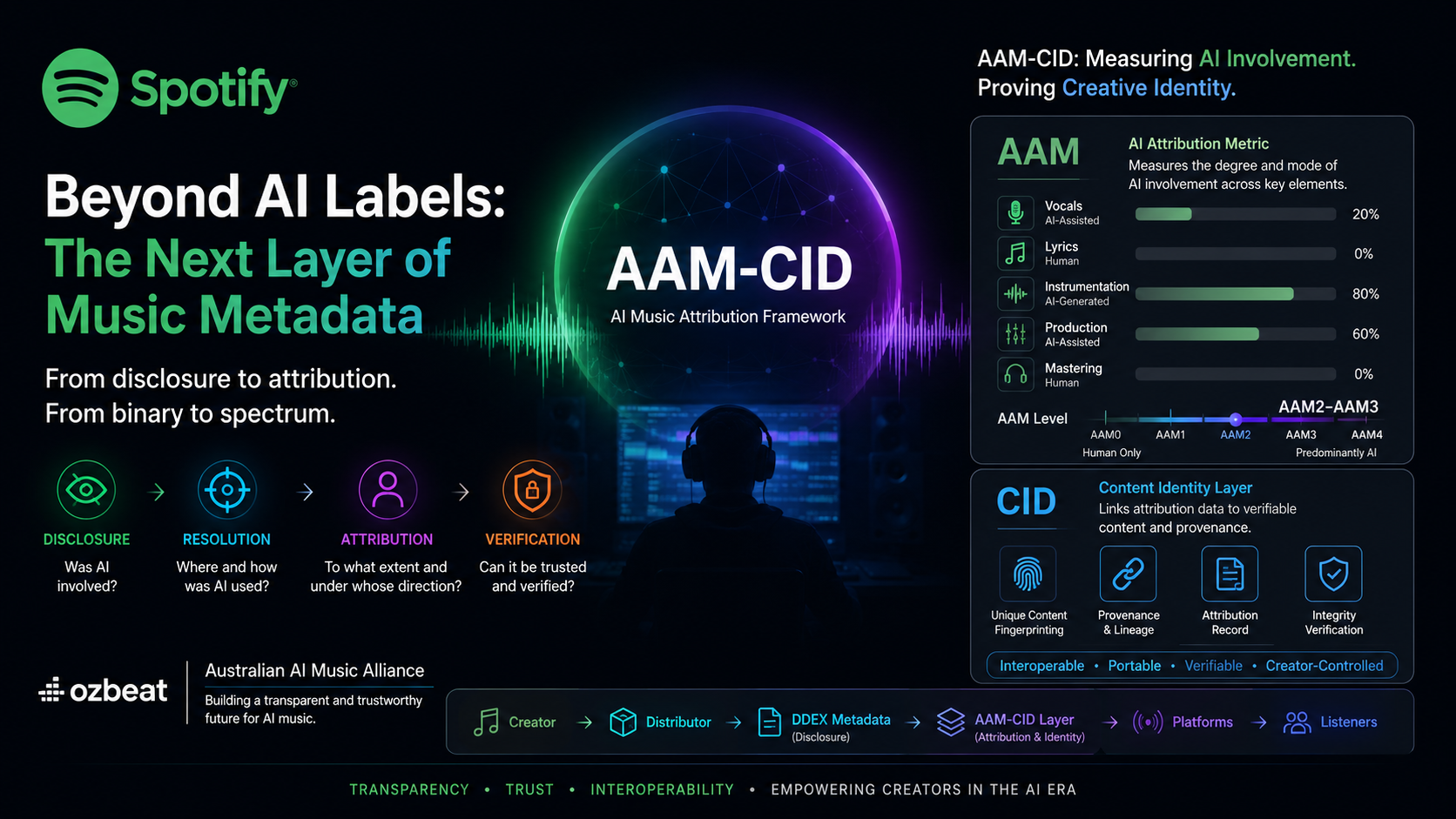
On April 16, 2026, Spotify launched AI Credits in beta, introducing a new way for artists to disclose how AI was used in the creation of their music. For the first time, listeners can see whether — and how — AI played a role in a track’s creation, with vocals, lyrics, and production credits reflecting AI involvement directly inside the Song Credits panel.
The infrastructure behind it is DDEX, the metadata standard that already moves every release through the global distribution pipeline. DistroKid became the first distributor to wire its upload flow into the new fields. More are coming — Believe, CD Baby, FUGA, IDOL, Amuse, EMPIRE, SonoSuite, Revelator and others have all committed.
This is a meaningful step. For the first time, the music industry has a shared way to say “AI was here” in a structured, machine-readable form that flows from the studio to the listener.
What Spotify and DDEX got right
Sam Duboff, Spotify’s Global Head of Marketing and Policy, framed the announcement around a simple but important idea: AI in music creation is a spectrum, not a binary. Forcing every track into “is AI” or “is not AI” misrepresents how artists actually work. A producer might use AI for arrangement sketches and record vocals entirely by hand. A songwriter might use AI lyric suggestions but rewrite every line. These are not the same as a fully generated track, and they shouldn’t be labeled as one.
The DDEX standard reflects this. It allows disclosure across vocals, instrumentation, lyrics, and post-production, with three levels of AI involvement: none, partial, or fully. This is a strong foundation, and one we’re glad to see the industry rally around. It establishes the principle that disclosure belongs in the metadata layer, alongside the artist, songwriter, and producer credits that have always defined a recording.
Building on a shared foundation
At ozbeat.ai and the Australian AI Music Alliance, we’ve been working on a complementary layer of this same problem. In February 2025, the Australian AI Music Alliance published the whitepaper: ISRC-AAM-CID: Establishing a Global Standardized AI Music Identifier, which extends standard ISRC identifiers with two additional dimensions: a finer-grained scale for AI involvement, and cryptographic provenance.
The AAM scale runs from AAM0 (no AI involvement) through AAM4 (fully AI-generated), with three intermediate levels that distinguish, for example, AI-assisted ideation from AI-co-created arrangement from AI-driven production with human direction. The CID component anchors each disclosure to a verifiable, tamper-resistant identifier, so that disclosures can be independently audited and trusted across the supply chain.
We see this as a natural extension of the work Spotify and DDEX have launched. The DDEX AI Ad Hoc Group, formed in April 2025, was created precisely to evolve the standard as the industry’s needs become clearer. The MEAD specification where the new AI fields live was designed from the start to accommodate richer metadata over time. AAM-CID maps cleanly into that architecture.
Why the next twelve months matter
The work ahead is about resolution and reach.
On resolution: as AI tools become embedded in everyday production workflows, the distinction between AI-assisted and AI-generated will become more important, not less. Finer disclosure gives artists who use AI responsibly a way to share exactly how they work, and gives listeners a more accurate picture of what they’re hearing. It also helps protect creators in the middle of the spectrum from being grouped with content they didn’t make — a concern that grows as detection tools become more aggressive.
On reach: DistroKid is the first distributor live with end-to-end AI Credits delivery, and many more — Believe, CD Baby, FUGA, IDOL, Amuse, EMPIRE, SonoSuite, Revelator — have publicly committed to follow. The faster this rollout reaches every distributor and every DSP, the sooner artists have a real choice to disclose. We want to help accelerate that.
What we’re doing
The Australian AI Music Alliance is implementing the AAM-CID framework as a working layer that maps onto DDEX MEAD fields. A track disclosed through our system carries both the granular AAM level for verification and the standard DDEX tag for display, so it remains fully interoperable with Spotify, Apple Music, and every other DDEX-compliant platform.
We’re engaging directly with DDEX and Spotify to contribute to the AI Ad Hoc Group’s work, and with the Content Authenticity Initiative to explore how music can be brought into the C2PA provenance framework alongside images and video. Our goal is to add useful resolution where the spectrum demands it, while keeping everything interoperable with the standards the industry has agreed on.
Where this goes next
In the coming months, we’ll be publishing the AAM-CID specification under an open license, and announcing partnerships with distributors who want to offer granular disclosure as a differentiated service to their artists.
We’d like to hear from anyone working on this problem — labels, distributors, AI music platforms, creators, policy researchers. The standards that take shape over the next twelve months will define how a generation of music is credited, paid, and trusted. We’re optimistic about where this is heading, and we’re glad to be building alongside the partners making it happen.