Sydney, Australia — September 2026 — Following the official release of the AAM 2.0 White Paper, OZBeat AI has launched the AAM 2.0 B2B Declaration Module, turning the framework for structured AI music disclosure into an implementation-ready solution for music distributors, platforms and other industry partners.
The new module is designed to sit within an existing music upload and metadata workflow, allowing AI contribution information to be collected alongside the information distributors and platforms already receive from artists and rights holders.
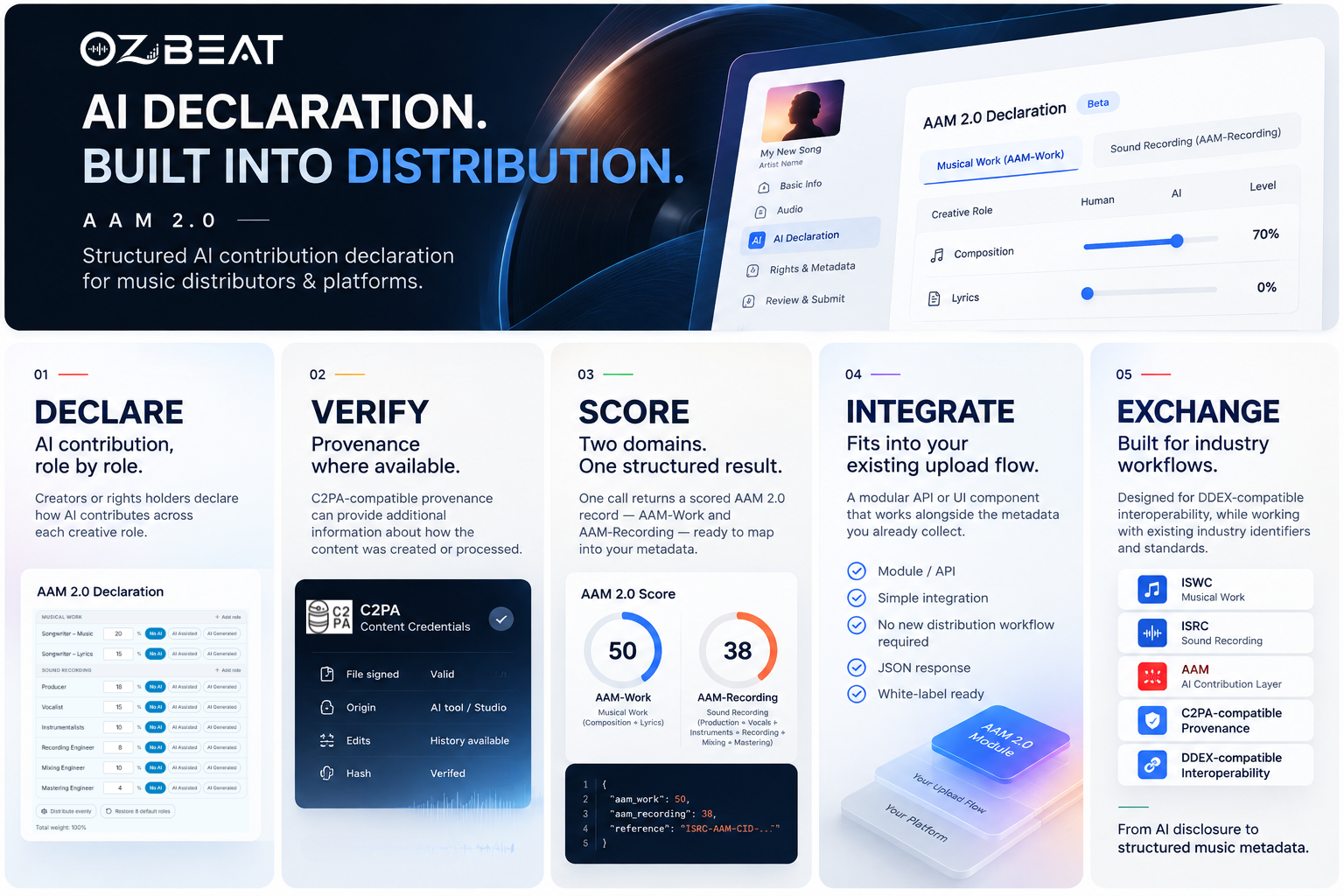
Rather than introducing another standalone registration process, the module brings AAM 2.0 directly into the point where music enters the digital supply chain.
From White Paper to Working Module
AAM 2.0 introduces two separate contribution domains: AAM-Work, covering AI contribution to the Musical Work, including composition and lyrics; and AAM-Recording, covering AI contribution to the Sound Recording, including vocals, instrumentation, production, recording, mixing and mastering.
The B2B module translates this framework into a practical declaration workflow.
Creators or rights holders can declare AI participation at the Creative Role level. The module then structures those declarations and produces AAM-Work and AAM-Recording results that can be retained as structured records and integrated into downstream systems.
The implementation can be summarised through five functions:
DECLARE · VERIFY · SCORE · INTEGRATE · EXCHANGE
DECLARE — Capture AI contribution role by role across the Musical Work and Sound Recording.
VERIFY — Where available, read C2PA-compatible provenance and Content Credentials as supporting information for the declaration.
SCORE — Generate separate AAM-Work and AAM-Recording results based on the AAM 2.0 framework.
INTEGRATE — Embed the declaration module into existing upload workflows and exchange structured results through system interfaces.
EXCHANGE — Prepare structured AI contribution information for use across music-industry workflows, including DDEX-compatible interoperability.
Designed Around Existing Music Infrastructure
A key principle of the implementation is that AAM does not seek to replace the music industry's existing identifiers or data infrastructure.
ISWC continues to identify the Musical Work.
ISRC continues to identify the Sound Recording.
AAM provides an additional structured AI Contribution Layer.
C2PA-compatible provenance can provide supporting information about the origin and processing history of digital content, while AAM describes the structure and degree of AI contribution.
In simple terms:
C2PA establishes provenance. AAM establishes contribution structure.
The module is designed so that these different information layers can work together without requiring distributors or platforms to rebuild their existing music delivery architecture.
Built for Distributors and Platforms
For distributors, labels and platforms, one of the practical challenges around AI music is not simply detecting AI-generated content. It is determining what information should be collected from creators, how that information should be structured, and how it can move through existing industry systems.
The AAM 2.0 B2B Module is designed specifically around that problem.
Instead of reducing a release to a single “AI” or “non-AI” label, it can capture which creative roles involved AI, whether that involvement occurred at the Musical Work or Sound Recording level, and the declared degree of AI participation.
This creates a more granular information layer that downstream organisations can interpret according to their own policies and business requirements.
Moving from Framework to Implementation
The release of the B2B module marks the next stage of AAM 2.0: moving from a published framework into practical industry implementation.
OZBeat AI will now begin discussions with music distributors, platforms, labels, rights organisations and technology partners around integration, interoperability and real-world deployment.
The objective is straightforward:
Make structured AI music declaration part of the existing music workflow — rather than another system sitting outside it.
With the AAM 2.0 White Paper defining the framework and the B2B module providing an implementation path, OZBeat AI is moving the project from AI disclosure as a concept to AI contribution data that can be operationally collected, structured and exchanged.